
What AI systems actually look for when they select a source
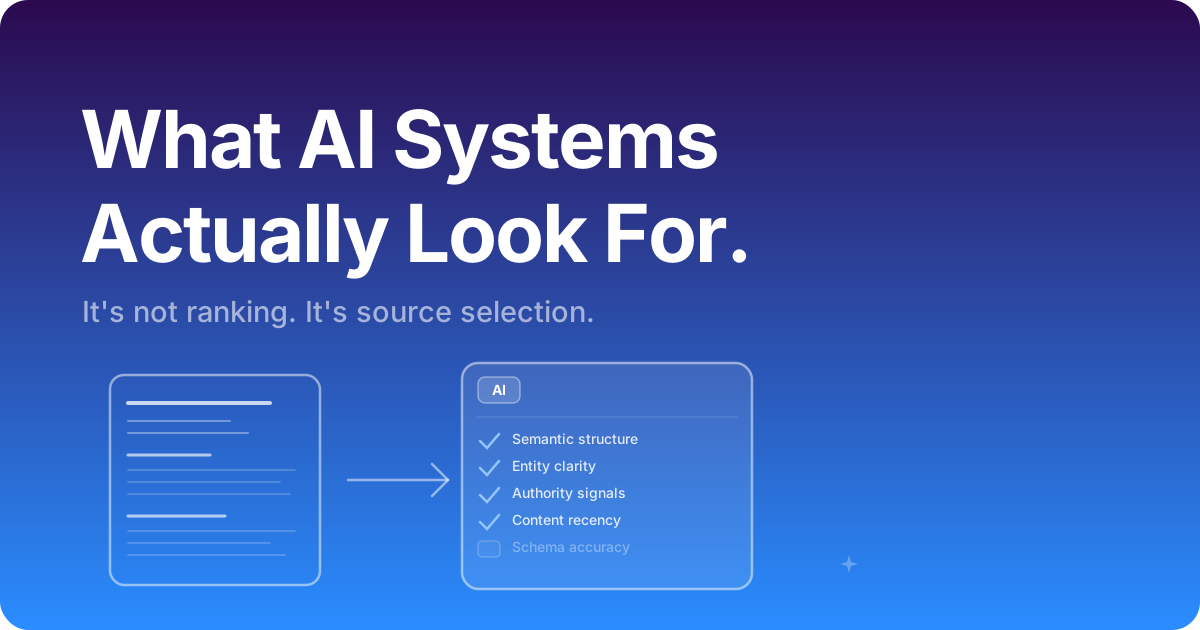
AI systems don't rank pages. They select sources. The distinction isn't semantic, it changes the entire optimization model. A ranked page competes for position. A selected source competes for trust. Understanding what earns that trust is where AI search optimization starts.
Most content programs are built around the ranking model. The signals that drive traditional search performance are well-documented and widely optimized for. The signals that drive AI source selection are different, and most organizations haven't mapped them.
Below are the five categories AI systems evaluate when deciding whether to cite a source. Each one is specific. Each one is addressable.
1. Semantic structure
AI systems navigate pages by structure, not by reading sequentially from top to bottom. When an AI system processes a page to determine whether it can answer a specific question, it uses the heading hierarchy as a map. H1 defines the subject of the page. H2s define the major claims or subtopics. H3s define the supporting detail within each.
A page structured for human reading flow, where headings are chosen for visual effect or editorial interest rather than topical precision, gives AI systems an unreliable map. The system may be unable to identify where the answer to a specific question lives, or may misattribute a claim to the wrong section.
The practical test: read your page headings in isolation, as a list, without the body copy. Do they describe the content of each section precisely? Could someone extract the page's argument from the headings alone? If not, the semantic structure needs work.
2. Entity clarity
Entity clarity is the degree to which a page is unambiguously about a single, well-defined subject. AI systems are significantly more likely to cite pages that demonstrate strong entity clarity because the citation risk is lower. A page that's clearly about one thing, with that thing defined, named, and consistently referenced throughout, gives the AI system confidence that citing it will be accurate.
The failure mode is common and worth examining closely. A page covering "our content strategy approach" may reference several related concepts without establishing clear boundaries between them. To a human reader who already knows the company, this reads as coherent. To an AI system evaluating whether this page is a reliable source on any one of those topics, it reads as ambiguous.
Entity clarity requires being deliberate about scope. Every page should have a primary entity. Supporting entities should be clearly subordinate to it. Vague references ("this approach", "the strategy") should be replaced with named, specific terms wherever the AI system might need to extract a claim.
3. Authority signals
AI systems evaluate authority differently from traditional search engines. Backlink quantity and domain authority scores are less relevant than the clarity of attribution within the page itself.
The signals that register: named authorship with verifiable credentials, clear organizational attribution, citations to primary sources where claims are made, and references to first-party data or original research. A page that states a claim and attributes it to a named author at a named organization, with a link to the source, gives an AI system a complete chain of attribution. A page that states the same claim without attribution gives the system no way to verify it.
This matters most for factual claims and statistics. Any sentence that makes a quantifiable assertion should be attributed inline, not in a footnote, not in a bibliography, but in the same sentence, in a way the AI system can parse without following a link.
4. Content recency
AI systems continuously re-evaluate sources. A page that performs well today can lose visibility within months if it isn't maintained. Static optimization decays.
Recency preference varies by engine. A Conductor analysis tracking 1,056 data points across ChatGPT, ChatGPT Search, Perplexity, Google AI Overviews, Google AI Mode, Gemini, and Claude (September 2025 through March 2026) found that each AI engine exhibits a distinct source preference and editorial identity. Perplexity, for example, gives content published within 30 days roughly 3.2× more citations than older material. ChatGPT's cited content ran approximately 458 days newer than comparable organic search results on average. (Conductor/Profound, 2026-05)
Recency bias is not solely about publication date. It is about evidence of ongoing maintenance: updated statistics, revised claims that reflect current conditions, and content that hasn't been superseded by more recent material on the same topic.
For most content libraries, recency is the most neglected signal. Publishing frequency gets attention; update cycles for existing pages do not. A page from two years ago that contains accurate, well-structured information may still lose citation preference to a more recently maintained page on the same subject, even if the older page is substantively better.
Maintaining and updating existing content, rather than treating each piece as a finished artifact, is not a publishing strategy preference. It is a technical requirement for sustained AI search visibility.
5. Technical performance and accessibility
AI systems can't cite what they can't reliably access and interpret. Technical performance matters as a baseline: pages that load slowly, have significant render-blocking issues, or return inconsistent content for different crawlers create signal noise that makes AI evaluation harder.
Schema markup is the most direct technical signal. Correctly implemented and maintained schema tells an AI system what type of content the page contains, who produced it, when it was published, and what it's about. The key word is maintained. Schema that was implemented at launch and never updated may accurately describe a page that has since changed significantly. That mismatch creates a discrepancy between what the page claims about itself and what it actually contains.
Crawlability and indexation are necessary but not sufficient. A page that's indexed and crawlable is eligible for AI evaluation. Whether it passes that evaluation depends on the signals above.
Why this compounds over time
The five signal categories above interact. A page with strong entity clarity and precise semantic structure but outdated content will lose standing over time. A page with current, well-attributed content but poor heading structure may never be selected despite its quality. All five need to be present, and all five need to be maintained.
This is the core reason static optimization decays. A one-time audit and remediation improves performance at the point of execution. Without ongoing maintenance across all five signal categories, that performance erodes as AI systems re-evaluate sources against a continuously updating competitive set.
As of August 7, 2026, industry estimates suggest a substantial majority of B2B buyers use AI to shortlist vendors before speaking to sales, though the precise figure varies across surveys and has not been confirmed by a single authoritative study. The shortlists those systems produce are built from sources that score well across all five categories, consistently, over time. Maintaining that standing requires treating AI search visibility as an ongoing operational discipline.
See how your pages score across these five signal categories, semantic structure, entity clarity, authority signals, recency, and technical performance. Run your Free AI Search Audit
Nishan
Content strategist at Optigent, specialising in GEO, AI search visibility, and B2B content optimisation.