
What 7,000 pages taught us about AI search optimization
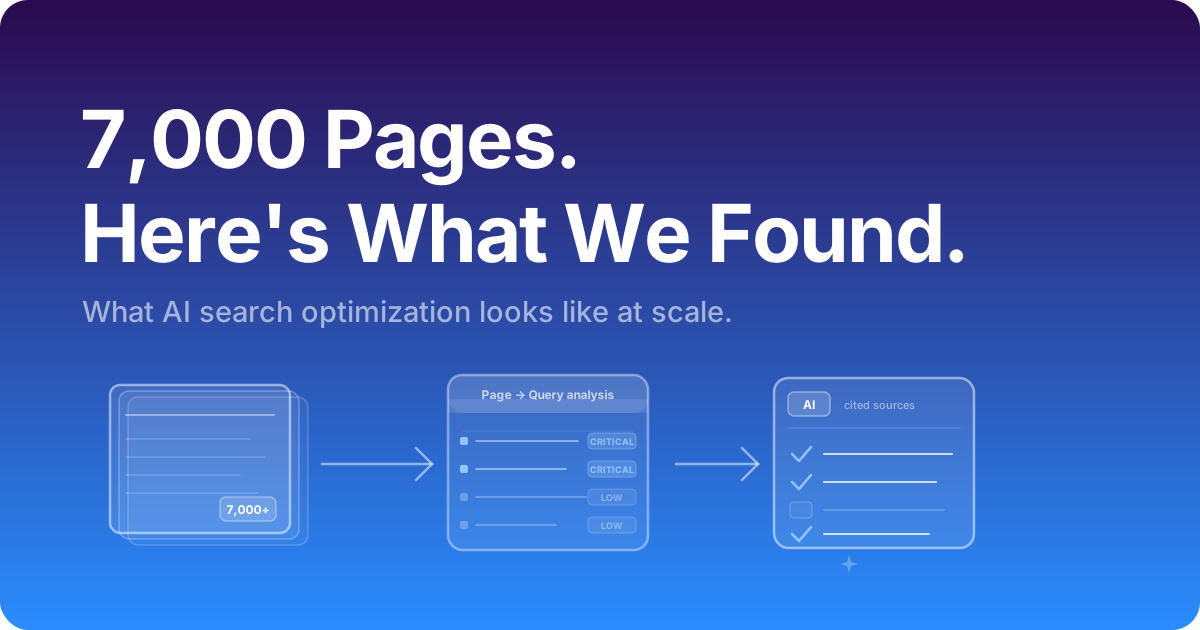
When you optimize 7,000 pages for AI search, patterns emerge fast. Some signals matter more than expected. Some optimization assumptions break down at scale. This post is what we learned. And what it means for any team trying to build sustainable AI search visibility.
The client
A large public sector organization. More than 10,000 employees across multiple regions. A multi-lingual website with over 7,000 pages built up across years of fragmented team ownership, each section managed independently, with no central coordination or shared strategy.
The result was a content library that reflected how the organization had grown rather than what it needed to communicate. Duplicate pages covering the same topics from different angles. Outdated information sitting alongside current content with no way to distinguish between them. Contradictory messaging across sections owned by different teams. Broken links throughout.
No AI search optimization strategy existed anywhere in the organization. No methodology. No expertise. And no internal capacity to execute a remediation at this scale, which ruled out the manual alternative before it was seriously considered.
The mandate was clear: audit the full website, build an AI search optimization strategy from scratch, and deliver a prioritized roadmap that leadership could act on.
What we found
The findings fell into three categories: AI interpretability, technical health, and content structure. All three were present across the library. But they weren't equal.
Technical problems — broken schema, crawlability issues, inconsistent markup — were there, but they were not the dominant gap. Most pages were technically accessible. AI systems could reach them. What they couldn't do, consistently, was understand them.
The dominant gap was interpretability. Pages that were technically sound were frequently invisible to AI systems because those systems couldn't reliably determine what the page was about or whether its claims could be confidently attributed. The content existed. The AI systems couldn't surface or use it.
Structural issues compounded this. Across the library, multiple pages covered the same topics from different angles, often with contradicting information and no clear source of truth. For AI systems evaluating which source to cite, conflicting signals across pages are as problematic as a poorly structured individual page.
The implication cuts across all three categories: for AI systems to surface and cite your content, they first need to understand it. Interpretability, technical accessibility, and clear structure have to work together. A gap in any one of them limits what AI systems can do with the others.
What moved the needle
The first was a page-to-query relevancy analysis. Before touching individual pages, we mapped the existing content library against the topics and queries the organization needed to be cited for. That analysis drove everything that followed — which pages were worth optimizing, which needed to be consolidated or retired, and where genuine content gaps existed. Without it, remediation effort gets distributed across a library based on instinct rather than evidence.
The second was consolidation and content recency. Where multiple pages covered the same topic with overlapping or contradicting information, we identified the strongest source of truth and consolidated around it. Pages that survived consolidation were then assessed for currency — outdated information replaced with accurate, current content, and publish recency updated to reflect it. AI systems continuously re-evaluate sources and favor recently maintained content. Consolidation resolves the conflicting signal problem. Recency keeps the resulting pages competitive over time. The two interventions work together.
Schema remediation mattered, but only after this work was done. Correctly implemented schema on a page that AI systems still find ambiguous or outdated performs worse than expected. The order matters: establish what each page needs to be authoritative on, then layer the technical signals on top.
What scale reveals that single-page audits don't
Optimizing one page, or ten pages, can produce misleading conclusions. A single page with strong entity clarity and current attribution will perform well. The question is whether that performance reflects the content quality or whether it's an outlier in a library where the surrounding pages undermine the overall authority signal.
At 7,000 pages, the patterns are impossible to miss. The issues aren't page-level accidents. They're structural tendencies that reflect how the content was produced and governed over time. Fixing them requires a systematic approach, not a case-by-case review.
The prioritized roadmap we delivered reflected this. Critical-priority items were the pages with the highest combination of traffic potential, interpretability gap, and the lowest remediation effort that could be actioned quickly. Low-priority items were pages with limited potential regardless of optimization. Working from that hierarchy meant the organization could move immediately on the highest-impact work without waiting for a complete remediation to begin seeing results.
That sequencing is what made the engagement practical. 7,000 pages can't all be remediated at once. Understanding which ones matter most is the work that unlocks execution.
What it means for teams building AI search visibility
The patterns we found in this engagement appear across every content library we've audited. The scale here was unusual. The underlying issues are not.
Most B2B content libraries have significant interpretability gaps that aren't visible in traditional analytics. Traffic dashboards show aggregate performance. They don't show which pages AI systems can and can't reliably cite, or why. Teams making content decisions without that picture are optimizing against incomplete information.
The gap is addressable. But closing it requires knowing where it is first
Run a free AI Search Audit. See where your site stands.
Nishan
Content strategist at Optigent, specialising in GEO, AI search visibility, and B2B content optimisation.