
The Difference Between a Prompt and a System: Why One-Off AI Tools Don't Scale Messaging
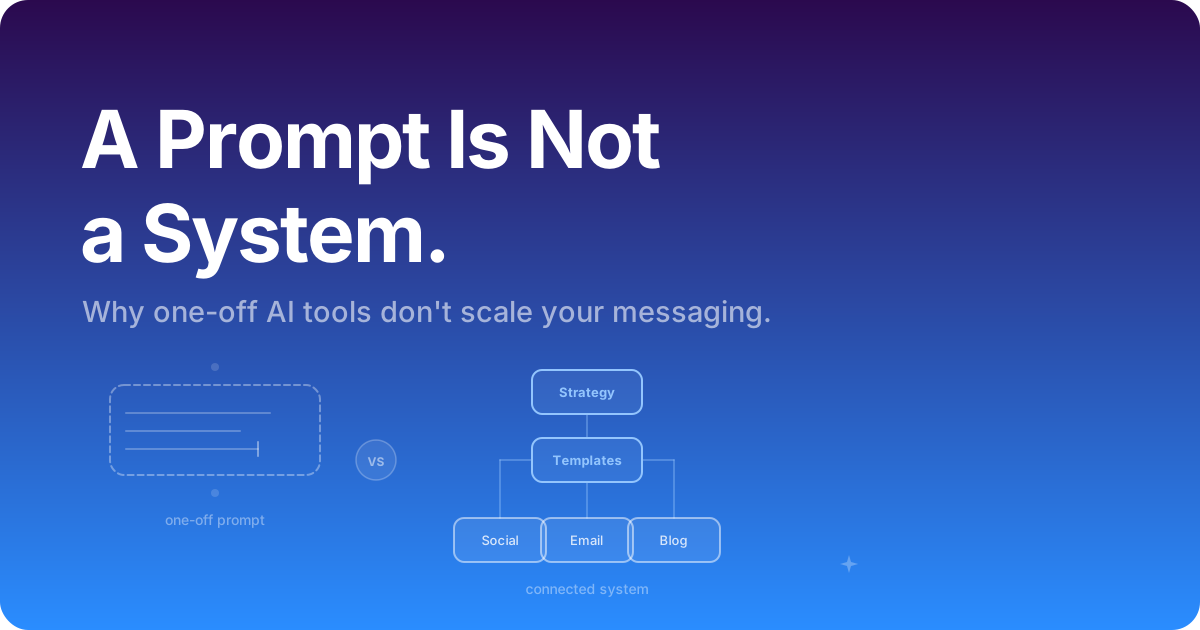
Research presented at the 2026 ACM FAccT conference found that prompt-based controls "do not transfer reliably across models, training methods, or deployment contexts", establishing that any messaging governance strategy built on prompt standardization alone operates without a reliable enforcement mechanism. If your team's current approach to AI content governance is a shared prompt library, you have a workflow convenience, not a system. The difference between those two things is architectural, not cosmetic, and it compounds over time in ways that are difficult to see until the damage is already distributed across dozens of published assets.
This piece makes the structural case for why. Not as an argument against prompts, prompts are necessary, but as a clear account of what a prompt cannot do, what breaks when teams mistake prompt discipline for system-level control, and how to tell which one you actually have.
What "Using AI for Content" Actually Looks Like Inside Most Marketing Teams Right Now
The operational picture inside most B2B marketing teams right now is not chaotic in a visible way. It looks productive. Writers are shipping faster. Briefs get drafted in minutes. Social copy appears on demand. The problem is structural and mostly invisible: eight to twelve people are each running independent AI sessions with no shared memory, no shared constraints, and no enforcement layer between the model's output and the published asset.
Each session starts from scratch. The model doesn't know what was written yesterday, what terminology the company has standardized, which claims have been approved by legal, or what voice decisions the brand team made last quarter. It knows what the individual operator told it in that session, and only that, and only for that session.
Forrester's State of B2B Content Survey (2025) identified inefficient content creation and review as content decision-makers' top operational challenge, and attributed the root cause directly to fragmented, one-off workarounds built when no shared system exists. The pattern Forrester observed is consistent with what content operations leaders describe: individual contributors develop their own prompt approaches, share them informally, and the result is a distributed set of personal workflows that produce output with no common baseline.
This is not a skills problem. The people doing the work are not failing to apply effort. The problem is that the unit of work; a single session with a generative AI model, has no memory, no persistence, and no relationship to any other session anyone else on the team ran before or after it. That's an architectural constraint, not a training gap.
The consequences take time to surface. Brand voice diverges gradually across asset types. Positioning statements drift between channels. Terminology that one team member has standardized appears inconsistently elsewhere. And because each individual piece looks reasonable in isolation, models are good at producing plausible, coherent prose; the fragmentation doesn't announce itself in any single asset. It accumulates quietly across a body of published content.
By the time it's visible, it's already in the training signal that AI systems use to represent your brand.
Why the Prompt Is the Wrong Unit of Governance
A prompt is an instruction. It is delivered at the start of a session, interpreted by the model in that moment, and has no effect on any other session before or after it. When the session ends, the instruction ends with it.
This is not a limitation that better prompt engineering can overcome. It's the architecture of how session-based generative AI works. The 2026 ACM FAccT research makes this concrete: prompt-based controls and their effects do not transfer reliably across models, training methods, or deployment contexts, and governance mechanisms that rely solely on text-level prompt prescriptions may produce weak or non-functional safeguards. The researchers aren't arguing that prompts are useless. They're arguing that prompts are the wrong unit for the job of governance.
The distinction matters because practitioners on the other side of this debate, including structured prompt engineering frameworks promoted for enterprise use in 2026, position standardized prompts as the primary mechanism for achieving consistent AI output at scale. That framing treats prompt standardization as sufficient. The ACM FAccT finding treats it as necessary but not sufficient, which is a substantively different claim. This is an actively contested position in the practitioner space; frame it as contested, not settled, if you're advising on governance architecture.
What the debate reveals is a category error that's worth naming directly: prompt engineering is a skill. Governance is infrastructure. Confusing them is like confusing a coding convention with a version control system. The convention is useful. It doesn't enforce itself, doesn't persist across contributors, and doesn't accumulate shared context over time.
A system, by contrast, has memory. It holds brand decisions made last quarter and applies them to work produced this quarter. It carries the same constraints regardless of which operator is running the session. It doesn't depend on every individual contributor remembering to load the right prompt at the start of every session, because the constraints aren't in the prompt. They're in the infrastructure the prompt runs inside.
Prompt engineering belongs inside that infrastructure. It's the interaction layer, not the governance layer. Teams that have built only the interaction layer and called it a strategy are not doing anything wrong, they're doing what makes sense given the tools that became available first. But the architectural ceiling is real, and the evidence of hitting it is accumulating across B2B content operations at scale.
What Breaks at Scale When There's No System
The downstream evidence of ungoverned AI content is measurable across several dimensions, and the data points in the same direction consistently.
Brand voice fragmentation is the most immediate consequence. Storyblok's 2026 research found that 73% of shoppers say they are less likely to buy from a brand when messaging appears inconsistent across digital channels. At the content velocity that AI enables, crossing that threshold becomes structurally easier: more output, more operators, more sessions, more divergence.
Campaign error rates track directly to governance maturity. Stensul's 2026 survey found that nearly nine in ten organizations without comprehensive governance reported at least one campaign error in the previous year, and governance maturity was the predictive variable. The implication is that the errors weren't primarily caused by individual contributor mistakes; they were caused by the absence of a system that would have caught them.
The commercial cost of this pattern, in aggregate, is substantial. Forrester (July 2026) estimated that ungoverned generative AI costs B2B companies more than $10 billion in enterprise value, attributing the loss directly to the blank-page problem: without a governance layer, every contributor reinvents brand voice with each new prompt. That framing is significant regardless of the precise number, because it positions the cost as structural rather than incidental.
AI visibility risk is the dimension most content operations leaders haven't yet priced in. As of September 3, 2026, 70% of marketers report that AI visibility is a top priority for their CMO or CEO, per Forrester's B2B Summit Survey (March 2026). The mechanism matters here: large language models that respond to buyer queries are being trained on, or are retrieving from, your published content. If that content carries inconsistent positioning, inconsistent terminology, and inconsistent claims across a body of work, the signal those models absorb is inconsistent, and the representation of your brand in AI-mediated buying decisions reflects that inconsistency back to buyers.
You can run a free AI search audit to see what AI systems are currently surfacing about your brand. What that audit typically reveals is not that AI tools misrepresent brands maliciously, it's that they accurately reflect the inconsistency in the content those brands have published.
Search risk compounds this further. Google began issuing manual actions specifically targeting scaled AI content abuse in June 2025, and enterprise SEO practitioners have documented a pattern where brands on the early upswing of an AI content traffic curve are unaware of the quality assessment phase that follows. The risk isn't AI content per se. It's ungoverned AI content that produces volume without coherence.
The Conductor 2026 State of AEO/GEO CMO Investment Report found that 94% of enterprise organizations plan to increase AEO/GEO investment in 2026, and that generating AI-optimized content at scale is simultaneously the top stated strategy and the top stated challenge. The gap between those two things is exactly the gap this piece is about.
The Difference Between a Tool You Pick Up and Infrastructure You Build Into
A hammer is a tool. A building code is infrastructure. You can use a hammer without knowing anything about building codes. But if you're constructing something that needs to stand up over time, under load, and across the work of multiple contributors, the hammer isn't the constraint; the absence of shared standards is.
Generative AI tools are, as the name suggests, tools. ChatGPT, Claude, Gemini, each one is a capable instrument for producing content. The operator picks it up, runs a session, puts it down. The next operator picks it up fresh. Nothing accumulates between sessions. Nothing enforces consistency across operators. The tool has no opinion about whether today's asset aligns with the positioning established in last month's campaign. That's not what tools do.
Infrastructure is different. Persistent context means the brand decisions made in the past are available to the operator running work today, not because they remembered to paste the right prompt, but because the system holds that context and applies it. Structured constraints travel with the content operation, not with the individual session. Terminology standards, voice parameters, approved claims, positioning boundaries; these exist in the system, not in someone's personal prompt file.
This is what the Optigent Engine is built to do: hold the context that makes individual AI interactions coherent across operators, asset types, and time. Not as a layer of bureaucracy, but as the accumulated intelligence that makes scaling possible without fragmenting. The intelligence layer is what separates execution at scale from output at volume. Volume without coherence is not a content operation, it's a documentation backlog.
The practical implication for a content or marketing operations leader is this: if your AI content governance strategy depends on every contributor loading the right prompt at the start of every session, you have a process that requires perfect human compliance to produce consistent output. That process will fail proportionally to team size and output velocity. It's not a failure of the people following it, it's a failure of architecture.
How to Evaluate Whether You Have a System or a Collection of Prompts
The diagnostic question is not "do we have prompts?" It's "what happens when a new contributor joins the team and produces AI content on day one, without reading any documentation?"
If the answer is "their output would be meaningfully different from everyone else's," you have a collection of prompts. The consistency you have is dependent on individual knowledge transfer, not on structural enforcement.
Run through these questions against your current setup:
1. Does brand context persist across sessions without manual loading?
If contributors need to paste a prompt or brief at the start of every session to maintain voice consistency, the context is not persistent, it's portable documentation. That's useful. It's not the same thing.
2. Do the same constraints apply regardless of which model a contributor uses?
Prompt-based controls don't transfer reliably across models, as the ACM FAccT 2026 research establishes. If your governance strategy would break when a contributor switches from one model to another, it's model-dependent, not system-level.
3. Is there an enforcement layer between the AI output and publication?
This doesn't mean manual review of every asset, it means a structural check that exists independent of whether any individual contributor remembers to apply it. If the check lives in someone's memory or in a checklist they open voluntarily, it's not an enforcement layer.
4. Do governance decisions accumulate over time?
When the brand team makes a positioning decision today, does that decision propagate forward into AI-assisted work next month automatically? Or does someone have to remember to update a prompt library and notify the team? If it's the latter, your governance is as current as the last person who remembered to update it.
5. Can you audit what the AI content operation has produced against brand standards at any point?
If there's no mechanism for running a coherent audit across your body of AI-assisted content, you can't know whether your governance is working. You can only know whether individual assets look right when you review them individually.
If you answered "no" to most of these, the correct interpretation is not that your team is doing poor work. It's that the infrastructure to support consistent AI content at scale doesn't exist yet, and the output you're producing is as consistent as the effort of your best contributors on their best days, with nothing that enforces that standard when conditions are less than ideal.
The Content Analyzer is a practical starting point for seeing where inconsistency has already accumulated in your published content. The audit surfaces signal that's hard to see when you're reviewing assets one at a time.
What This Means for How You Think About AI Content
The frame that most teams are working inside right now, "we're using AI for content", doesn't distinguish between using AI as a collection of individual tools and operating AI as a coherent production system. Both can produce volume. Only one produces consistency at scale.
The practitioner tutorials will keep telling you to write better prompts. That work matters. But if the prompt is the only governance mechanism in your content operation, you've built an excellent steering wheel on a car with no chassis. The craft of prompting is real; the ceiling it hits is also real.
The ACM FAccT 2026 research makes the ceiling concrete. The Forrester, Stensul, and Storyblok data make the cost of hitting it measurable. What they don't provide is the operational path from "collection of prompts" to "persistent infrastructure", because that path is specific to how your content operation is actually structured.
The diagnostic above gives you a starting point. If the five questions surface more gaps than you expected, the next step is understanding what persistent context actually looks like inside your specific operation, not as a concept, but as infrastructure you can build into and rely on.
That's the work. The tools are a precondition. The system is the strategy.
Nishan
Content strategist at Optigent, specialising in GEO, AI search visibility, and B2B content optimisation.