
The SEO playbook didn't break. It's just not talking to AI systems.
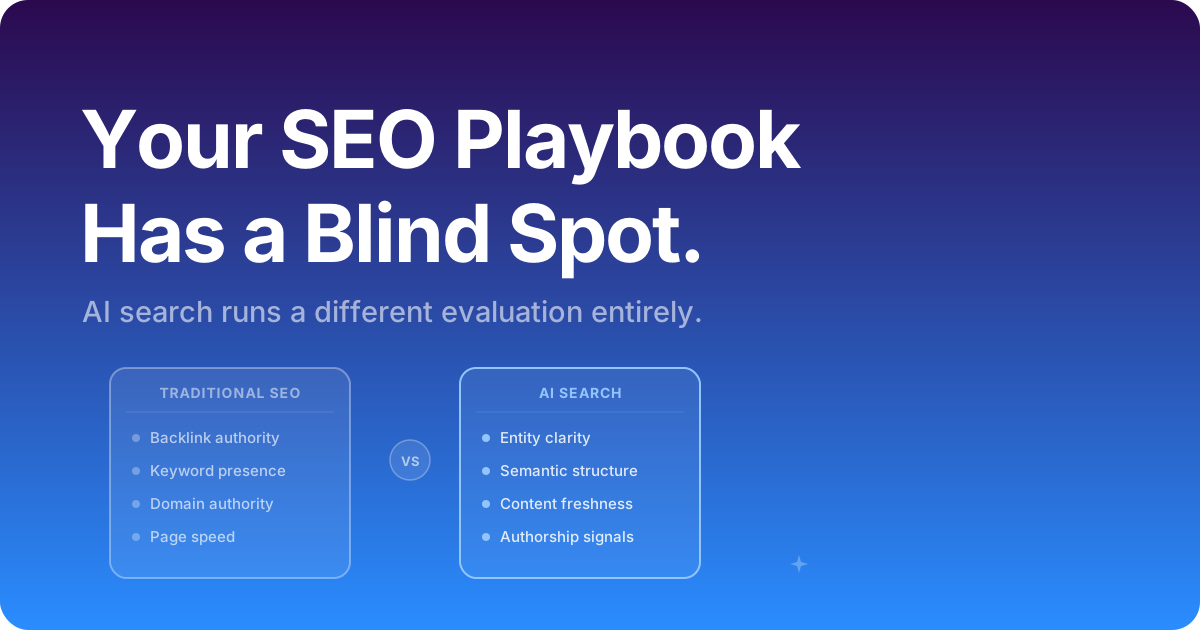
You've done the work. The content calendar runs. The technical audits are clean. And the traffic is still declining. The problem isn't effort. It's that AI systems are running a different evaluation, one that the standard content playbook wasn't built to pass.
This is not a failure of execution. It's a structural mismatch. Understanding the gap is the first step to closing it.
Two different evaluations running in parallel
Traditional search and AI search are both trying to answer the same question: which source best addresses this query? They reach very different answers, because they're measuring different things.
Traditional search engines evaluate pages on signals that a decade of SEO practice was built to optimize: backlink authority, keyword presence, page speed, technical markup as a hygiene signal, and domain-level authority accumulated over time. The underlying model is straightforward. Trusted sources link to other trusted sources, and pages with clear topical relevance rank for related queries.
AI systems operate differently. They don't rank pages in a hierarchy and pull from the top. They select sources based on how well a page's content can be understood, attributed, and used to construct a reliable response to a specific question. The signals they weight are different in kind, not degree.
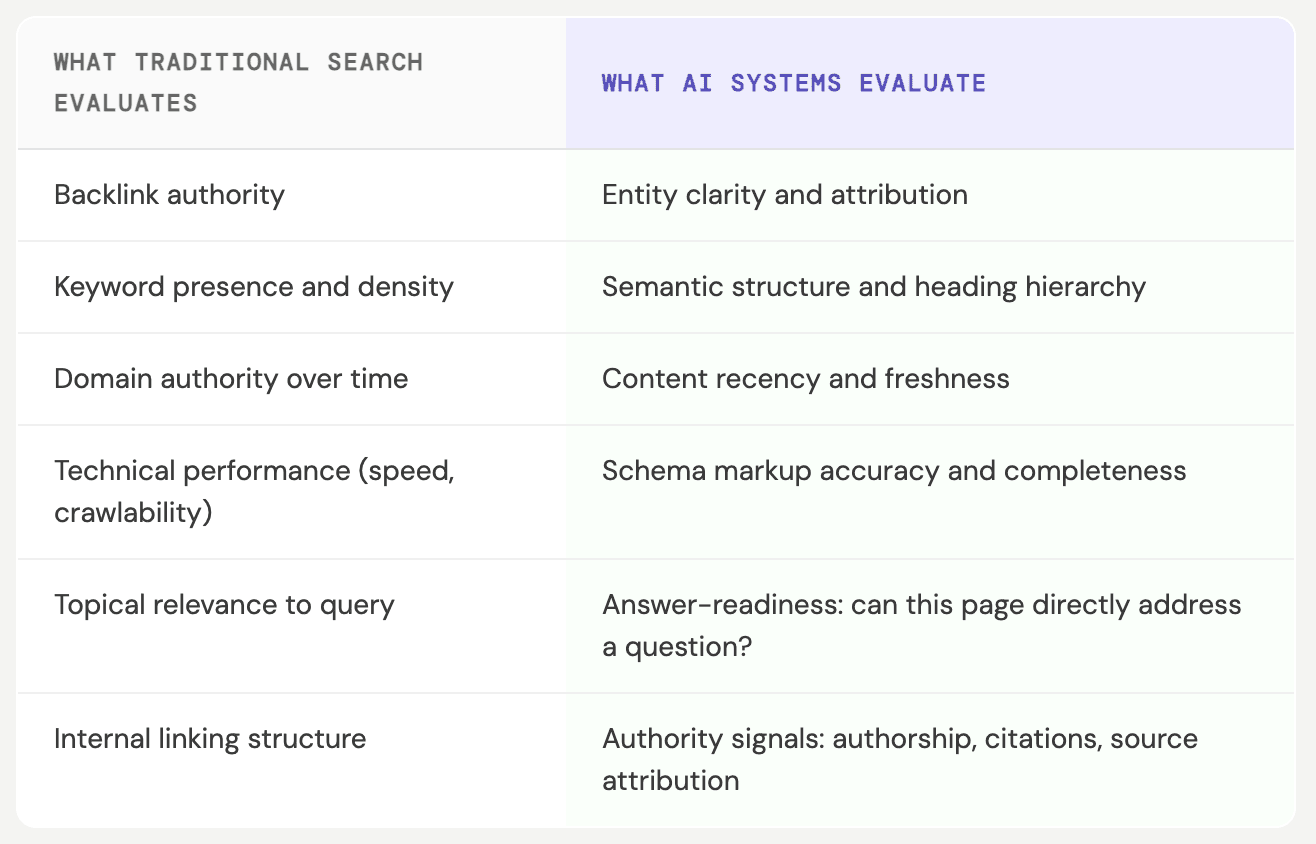
A page can perform well on every dimension in the left column and still be invisible to AI systems. Not because it's low quality. Because it isn't structured in a way AI systems can interpret with confidence.
The signals your current program may be missing
Entity clarity means a page is unambiguously about a specific thing. This sounds obvious, but most content programs produce pages that cover related concepts together, assume reader context, and use pronoun-heavy prose that's natural to read but harder for AI systems to parse reliably. A page about "our approach to demand generation" means something to a human who already knows the company. To an AI system evaluating source quality, it may be too ambiguous to cite.
Semantic heading structure means the H1, H2, and H3 hierarchy of a page mirrors how an AI system would navigate it to answer a specific question. Many pages are structured for human reading flow. The headline grabs attention. The subheadings provide section labels. But if a reader asked the AI to extract what this page says about a specific topic, the heading structure may not support that extraction cleanly.
Schema markup accuracy goes beyond implementation. Plenty of sites have schema present. Fewer have schema that's current, correctly attributed, and aligned with the actual page content. AI systems use schema as a shortcut to understand what a page is claiming about itself. Stale or misaligned schema creates friction in that interpretation.
Content recency matters more than most programs account for. AI systems continuously re-evaluate sources, favoring fresh and well-maintained content over static pages. A page that performed well six months ago may have lost relative standing as newer, better-structured content emerged in the same topic area. Gartner projects a 25% decline in traditional search volume as users shift to conversational AI. The systems processing that shift are not static, and neither are their evaluations.
Authorship and attribution signals do matter in traditional SEO, but they carry real weight in AI source selection. Pages with clear authorship, institutional attribution, and links to verifiable primary sources give AI systems more to anchor a citation to. Content without clear attribution is harder to cite with confidence, regardless of its quality.
Why your instincts may be pointing in the wrong direction
The natural response to declining organic performance is to look at what worked before and do more of it. More content. More backlinks. Better technical scores. That instinct isn't wrong. Traditional search performance still matters, and the signals that drive it remain relevant.
The problem is that doing more of the same won't close a gap that's structural. If your pages aren't legible to AI systems, producing more pages like them scales the problem rather than solving it.
The teams closing this gap aren't abandoning their existing content programs. They're extending them. They're adding the evaluation layer that AI systems run and auditing their existing content against it. In some cases, the remediation is light: adjusting heading structure, updating schema, sharpening entity clarity. In others, a page needs meaningful restructuring before AI systems will treat it as a reliable source.
Neither scenario requires starting over. Both require understanding what AI systems actually evaluate, then closing the distance between your current content and that standard.
What a proper evaluation looks like
The starting point is an accurate picture of how your existing content performs across AI search signals, not just traditional ones. That means evaluating semantic structure, entity clarity, schema accuracy, recency, and authorship signals at the page level, not inferring performance from aggregate traffic data.
Most content teams haven't had access to that evaluation. Traffic dashboards show aggregate decline. They don't identify which pages have structural gaps in AI legibility or what specifically would need to change.
That's what an AI search audit surfaces. Not a general content score. A direct read of how AI systems currently interpret your pages, where the gaps are, and what remediation looks like for each.
Understand exactly how AI systems currently interpret your content. The audit covers semantic structure, entity clarity, schema accuracy, and authority signals at the page level.
Get Your Free AI Search Audit
Nishan
Content strategist at Optigent, specialising in GEO, AI search visibility, and B2B content optimisation.