
Tribal Knowledge Is a Liability: How to Build Org Memory That Outlasts Any One Employee
A 2025 Enboarder survey found that institutional knowledge loss is HR leaders' top offboarding challenge, cited by 47% of respondents. A 2026 VentureBeat Intelligence survey found that 64% of enterprises had traced a confidently wrong AI agent answer to problems in their own company data, like missing or outdated business context.
Those look like two unrelated problems: an HR metric and an AI performance issue. They aren't. AI has made the older problem more expensive to ignore, and unmanaged tribal knowledge is the thread connecting both: the same gap that costs HR leaders a departing employee's expertise also cascades into incorrect AI outputs.
The organizations closing this gap aren't building better repositories. They're building org memory as infrastructure: a structured layer that captures how decisions actually get made, persists through turnover, and gives AI systems something accurate to reason over.
The piece below covers what you lose when a key person walks out, and why existing documentation strategies fail before anyone even leaves.
It also covers why the AI dimension has made this materially more expensive, and what a functioning org memory architecture actually looks like in practice.
What you're actually losing when a key person walks out
The instinct is to think about the job description: the deliverables, the meetings, the accounts. That's not all that walks out the door.
A 2025 Scribe report found that 71% of a company's know-how isn't documented. The same report puts the cost of that gap at roughly $15,120 lost per employee per year — $15.1 million annually for a 1,000-person company — in time spent searching for answers, recreating work, or documenting it manually.
Directionally, it aligns with what any organization experiences when a senior person leaves: a sudden, visible gap in operational continuity that no handover document fully closes.
The financial exposure compounds this. Applauz's research puts the cost of replacing a single employee at 50% to four times that person's annual salary, depending on role and experience level.
For a $150,000 role, that's a replacement cost floor of $75,000 and a ceiling of $600,000, before accounting for the productivity loss on work that simply doesn't get done the same way it did before.
Turnover at this level is not an edge case. BLS JOLTS data puts the private-sector voluntary attrition rate at 2.1% for August 2026 — annualized, that's in the neighborhood of 22–25% of a workforce turning over voluntarily each year.
That's not a crisis event to prepare for; it's the baseline. By the time someone is offboarding, the extraction window is too short, and the documentation pressure too high, to capture what actually matters.
The systems problem is that most organizations have no capture mechanism during the tenure, only a scramble at the end.
Why your documentation strategy is failing before anyone leaves
The standard response to the tribal knowledge problem is documentation: build a wiki, establish a Confluence instance, run knowledge base sprints. A meaningful portion of organizations have done exactly this. The results have not matched the investment.
Most knowledge-worker surveys on this point converge on the same picture: well-documented workflows are the exception, not the norm, and organizations commonly run multiple overlapping knowledge-management tools without consolidating them. The fragmentation is the symptom.
When updating documentation requires leaving the application where work is happening, navigating to a separate system, structuring content in a format that doesn't match how the knowledge surfaced, and doing all of this while the next task is waiting, most employees defer.
Within months, people stop trusting it. Within a year, it's maintained by the few people who feel personally accountable for it, not by the organization.
It's not really a willingness problem, either. The pattern in adoption failures generally traces to poor structure, weak search capability, and lack of integration into daily workflow, not to employee resistance to documentation as a concept.
The system design is asking for behavior that competes with getting work done, rather than emerging from it.
The harder diagnosis: most organizations are capturing explicit knowledge (process steps, policy documents, meeting notes) while missing tacit knowledge (judgment, heuristics, decision rationale) and contextual knowledge (the why behind decisions, not the what).
A playbook that says "escalate to legal when contract value exceeds $500K" captures the rule. It doesn't capture what happened that made someone write that rule — which is the information needed to handle the next edge case the playbook doesn't cover.
Documentation strategies fail before anyone leaves because they're designed around outputs — documents in a system — rather than around the actual knowledge transfer that needs to happen. The outputs become the measure of success. The knowledge gap persists regardless.
The AI compounding problem: why knowledge gaps cost more now than they used to
The tribal knowledge problem isn't new. What has changed is what it costs in an era where AI systems are being asked to reason over organizational context.
McKinsey's State of AI in 2026 report found that nearly nine in ten organizations (89%) now report regular use of AI in at least one business function. The remaining gap is scale, not adoption: only 44% report AI scaling across the enterprise, up from 38% a year earlier.
The gap between that adoption number and organizations actually seeing impact from it is consistently attributed to data quality and organizational context quality, not to model capability.
Agentic AI's production failures follow a similar pattern, though the figures that circulate for exactly how much is attributable to context quality specifically are not well-sourced; the more defensible, widely-cited number is that a large share of agentic AI pilots don't make it to production at all.
An organization investing in generative AI software while operating with unmanaged tribal knowledge is not only getting less value from AI, it's actively compounding the knowledge gap.
Every AI-assisted decision made on stale or incomplete context reinforces the wrong model. Every output a knowledge worker accepts without recognizing it's based on outdated information widens the gap between what the organization knows and what its AI systems can surface.
Organizations that haven't built functional org memory architecture are now scaling incomplete context rather than scaling accumulated knowledge.
What org memory architecture actually looks like
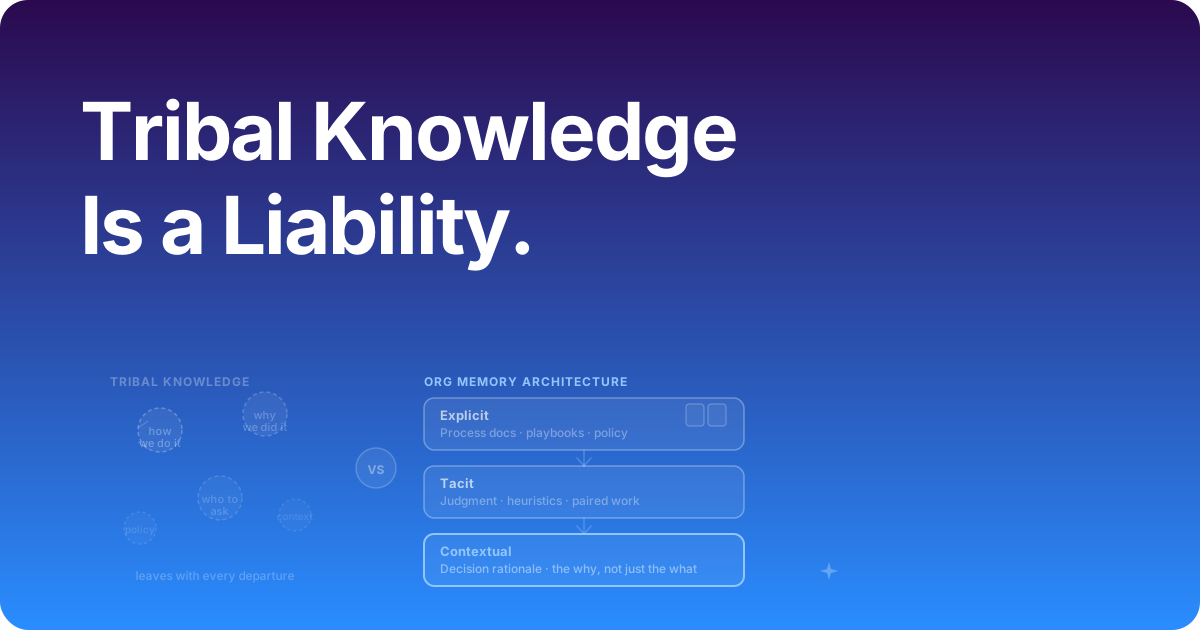
A functioning org memory system is a layered capture architecture designed around three distinct types of knowledge, with mechanisms embedded in existing work rather than bolted on as a separate documentation obligation.
Layer one: explicit knowledge. Process documentation, playbooks, policy documents, templates. This is what most organizations are already trying to capture. The failure here is, in the overwhelming majority of cases, maintenance, not creation; documents are written once and not updated when the process changes. Explicit knowledge systems need versioning, ownership assignment, and decay signals (documents older than a defined threshold that haven't been reviewed get flagged, not deleted).
Layer two: tacit knowledge. The judgment calls that never make it into a document: how a veteran account manager reads a client's silence, which vendor "yes" actually means yes, when to escalate a problem versus absorb it quietly. This is the hardest layer to capture because the person holding it usually can't articulate it on request; it only surfaces while they're doing the work, or training someone else to do it. Interviews don't capture it well. Shadowing, paired work, and after-action debriefs taken right after a judgment call — not reconstructed from memory weeks later — do.
Layer three: contextual knowledge. The why behind decisions, not merely the what. Decision logs that record not only what was decided but what was considered and rejected, and why. Context threads attached to standing policies that explain the situation that created them. This layer is the one most directly relevant to AI system quality: an LLM reasoning over an organization's decisions without access to the decision rationale will produce outputs that are structurally plausible but contextually wrong.
The capture mechanisms need to live inside existing workflows. Meeting summaries that auto-populate to structured knowledge repositories rather than sitting in a private folder. Decision logs embedded in project management software, not maintained separately. Retrospective templates that become a standing part of project closure, not an optional add-on.
The architectural principle matters more than any specific system: knowledge capture needs to happen at the point where knowledge surfaces, not in a separate system accessed deliberately.
If a content operations team's editorial process lives in a project management system, that's where knowledge about why a piece was structured a particular way needs to be captured, not in a separate wiki that someone needs to remember to update.
It's a system that captures the highest-leverage knowledge — the decisions, rationale, and heuristics that are most costly when lost — through mechanisms that don't require behavioral change at the individual level beyond what already happens in the course of work.
The adoption prerequisite: why change resistance kills better systems
The architectural problem above is solvable. Technology-first approaches — selecting and deploying a platform, then expecting adoption — consistently underperform approaches that map user need before platform selection.
This is not a new finding. It's a pattern that repeats because the procurement cycle rewards platform selection (a visible decision) over behavior change (a slower, less legible process).
The documented resistance factors are specific. Organizational change research puts the five primary resistance factors at:
- Fear of job security (78%) — employees who hold knowledge others don't have organizational leverage, and documentation removes that leverage.
- Lack of communication (65%) — teams that don't understand why the system is being implemented, and what it changes about their daily work, will not sustain use.
- Insufficient training (58%) — not training on the software, but training on the new workflow the software requires.
- Past negative experiences (52%).
- Loss of autonomy (47%).
The sequencing error most organizations make: buy the system, then train on it, then try to address resistance. This is an organizational change problem, not a software problem.
System design needs to account for the individual return, not solely the organizational one. These two facts are not coincidental.
They describe the same underlying failure: organizations that have not built the infrastructure to capture, maintain, and surface what they know are paying for that gap twice: once in human capital continuity, and once in AI output quality.
The solution is not a better wiki, a more thorough exit interview process, or a new documentation sprint. It is an architectural decision to treat org memory as a foundational layer, equivalent in organizational priority to the systems that handle financial data or customer records, because in an AI-integrated operating environment, it functions as infrastructure in exactly the same way.
Organizations that get this right will compound knowledge over time: each departure transfers context rather than destroying it, each new hire ramps against accumulated institutional intelligence rather than starting from friction, and each AI-assisted decision reasons over organizational reality rather than a degraded approximation of it.
The organizations that don't will keep absorbing the same recurring tax — on turnover, on onboarding, on AI deployment — without ever addressing the structural condition that creates it.
This is the problem the Optigent Engine is built to solve, and for marketing teams specifically, where the knowledge gaps show up most visibly in day-to-day execution, Optigent's content operations work addresses the workflow-embedded capture problem directly.
Book a discovery call to see where your organization's knowledge gaps are most exposed.
Nishan
Content strategist at Optigent, specialising in GEO, AI search visibility, and B2B content optimisation.