
How AI Visibility Impacts Conversion Rates
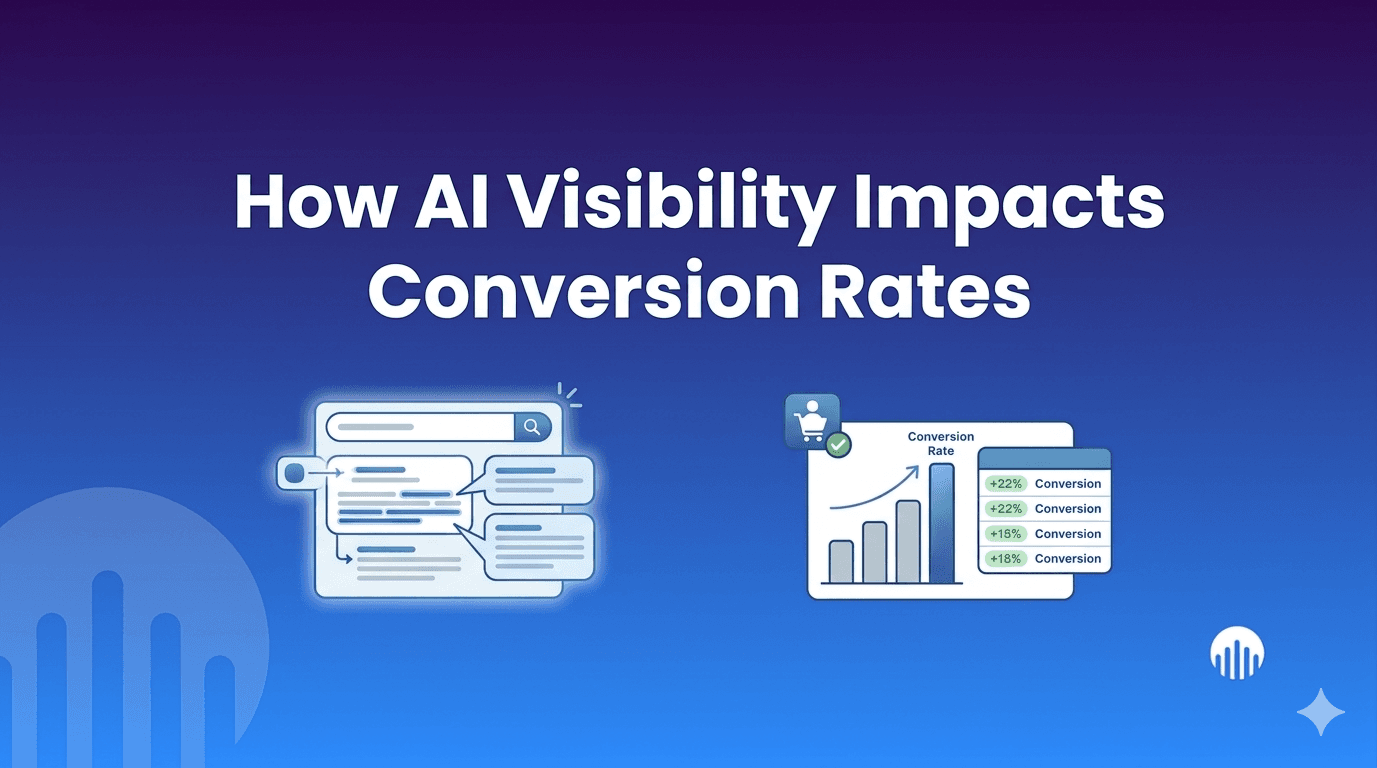
One of the more consequential shifts in 2026 is not that people are using AI to find brands, it is that the traffic arriving from AI engines is converting at a measurably higher rate than traditional organic search. A March 2026 analysis of 2.3 billion sessions (WebFX) found generative AI traffic recorded a 54.15% session conversion rate versus 45.23% for organic search. Ahrefs' own first-party data (June 2025) showed AI search accounted for 0.5% of their total traffic but drove 12.1% of all signups; a 23x higher conversion rate than their organic baseline. Adobe Digital Insights tracked AI referrals to US retail sites during the 2025 holiday season and found AI-referred visitors generated 31% higher conversion rates and 32% higher average order values than non-AI-referred visitors (January 2026).
The structural reason matters: in traditional search, a user evaluates your brand based on a headline and snippet. In an AI-mediated journey, the user has already received a synthesized summary of reviews, comparisons, and use-case fit before they click. Arrival intent is categorically different.
At Optigent, we track how that intent difference flows through the conversion funnel, and the downstream revenue implications are significant.
The trust transfer effect
When a generative AI system recommends your brand in response to a specific, high-intent query, the user arrives carrying the credibility of that system. If the AI states that a given vendor is the most reliable choice for a defined use case, the user reaches your site with reduced skepticism and a clearer purchase mandate than a user who found you through a paid ad or organic listing.
This dynamic is why AI Search Optimization is attracting budget that previously went to PPC: an AI citation functions as a third-party endorsement, not a paid placement.
Comparing conversion benchmarks: AI vs. traditional
Traffic source
User mindset on arrival
Conversion profile
Traditional search
Comparing options, evaluating features
Requires multiple visits and retargeting
AI citation click
Seeking confirmation of a decision already forming
Users frequently skip the awareness stage and move to consideration or intent
Social media referral
Interrupted browsing, low purchase intent
High bounce rates; demands a high-friction landing experience
The distinction is not volume, it is where the buyer sits in the decision process at the moment of first contact.
Three ways AI visibility affects revenue outcomes
1. Shorter sales cycles
Because LLMs synthesize reviews, tradeoffs, and pricing context before the user clicks, the educational phase of the buyer journey occurs inside the AI. When the user reaches your site, the "About Us" and "Features" pages are largely redundant. They are looking for a proof point or a conversion action; a trial, a demo request, a pricing page, not an introduction.
2. Higher lead quality (MQL to SQL)
AI systems match user-stated requirements to vendor positioning. A user who queries for an enterprise-tier solution and receives your brand as a recommendation has already passed a relevance filter that no paid channel replicates. The traffic you receive from AI citation has been pre-qualified against the user's own stated criteria, which reduces low-fit leads entering your pipeline.
3. Average order value and price anchoring
Adobe Digital Insights' January 2026 data found AI-referred visitors generated 32% higher average order values than non-AI-referred visitors during the 2025 holiday season. The mechanism is consistent with what Optigent observes across B2B clients: when an AI system positions a vendor in a specific tier or use-case context, users arrive with price expectations already shaped by that framing, rather than entering negotiation from scratch.
FAQs: AI visibility and ROI
Q: If AI visibility improves conversion rates, should I stop investing in traditional SEO?
A: No. Traditional SEO produces the structured, authoritative content that AI engines draw on when forming recommendations. Without a credible technical and content foundation; E-E-A-T signals, structured data, authoritative inbound links; the probability of AI citation drops materially. The two are complementary, not substitutes.
A user who arrives expecting one software experience and encounters another will exit immediately.
Q: How do I track AI-influenced conversions?
A: Start by isolating AI referral segments in GA4 using first-click attribution to capture the originating source before any mid-funnel touchpoints obscure it. Note that GA4 has structural limitations with AI-referred traffic, for a detailed breakdown, see Why GA4 Can't Properly Track AI Search Traffic and AI Search Attribution Models: Giving Credit in the "Dark Funnel".
How Optigent optimizes your conversion path
Visibility without conversion alignment wastes the opportunity. Optigent analyzes the gap between what AI systems are saying about your brand and what your landing pages deliver to a visitor who arrived based on that claim.
If an AI system is characterizing your offering in a specific way, your on-site content needs to confirm and extend that characterization, not contradict or ignore it. We identify the specific language patterns AI systems use when citing your brand and align your conversion pages to meet users where their expectations already are.
Get a Free AI Search Audit →
Nishan
Content strategist at Optigent, specialising in GEO, AI search visibility, and B2B content optimisation.