
Why You Can't Just "Ask ChatGPT" to Build Your Company's Knowledge Layer
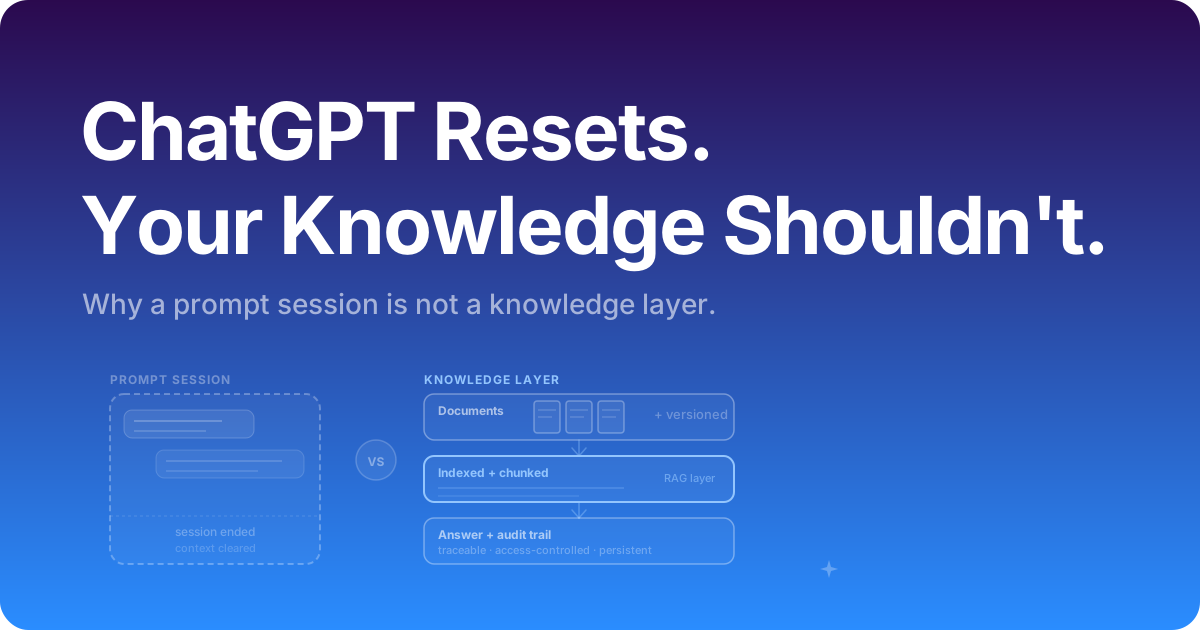
The phrase comes up in almost every conversation about AI adoption: "Why can't we just use ChatGPT for this?"
It's reasonable question. The interface is familiar, the capability is there, and the friction of deploying it is low compared to anything requiring IT involvement. But "asking ChatGPT" and building a company knowledge layer are different things at the architectural level: not different in degree, but different in kind.
Retrieval-augmented generation (RAG) reduces hallucination rates by 30–70% compared to standalone large language models, yet enterprise implementations of ChatGPT struggle with knowledge bases exceeding 50,000 documents that require custom chunking or multi-hop retrieval logic, the exact conditions that define a real company knowledge layer.
That gap is not a product limitation to be patched in the next release. It reflects a structural mismatch between what a prompt session is designed to do and what a persistent knowledge system must do.
This article works through that mismatch — the hallucination evidence, the governance exposure, and the architectural requirements — and how that has real organizational cost.
What "just asking ChatGPT" actually does to your company's knowledge
When a person opens a ChatGPT session and pastes in a document, then asks a question about it, several things happen. A context window is loaded, inference runs against that context, and an answer is generated. When the session ends, the context is discarded.
The next session starts fresh. Nothing was learned, stored, indexed, or made retrievable by anyone else in the organization. The interaction consumed a piece of company knowledge without contributing to any organizational memory.
That is the structural fact behind the "just ask ChatGPT" approach at scale: it is a series of isolated query events, not a knowledge system. There is no shared retrieval layer. There is no version control for the source documents. There is no record of what was asked, what answer was given, or what document state the answer was derived from. Two employees can ask the same question on the same day and receive meaningfully different answers based on which version of a document they happened to paste in, or whether they phrased the question differently.
According to GoSearch's Enterprise AI Knowledge Management Guide (2025–2026 data), a 1,000-employee organization loses an estimated $2.5 million annually from the inability to locate and retrieve information, with workers averaging 1.8 hours daily searching for what they need. That's the baseline cost, the problem before any AI is involved. A prompt-based interface layered onto unstructured, siloed data does not address that problem. It adds a new interaction surface on top of the same fragmented knowledge state. The query friction is lower; the underlying disorganization is unchanged.
The same GoSearch guide reports that 61% of companies admit their data assets are not ready for generative AI due to unstructured, siloed, or poor-quality data, and 70% find it difficult to scale AI projects that rely on proprietary data. Those numbers describe the ground condition that a knowledge layer has to resolve before inference quality matters.
A well-designed RAG architecture addresses data structure, retrieval logic, and document governance first. A ChatGPT interface addresses none of those things.
Whoever is asking "why not just use ChatGPT" is, in effect, asking why the organization needs to solve the structuring problem at all. The answer is that the structuring problem already exists, and every AI query run against unstructured data inherits it, then adds the risk of generating a confident-sounding wrong answer on top.
Why the hallucination problem gets worse, not better, at enterprise scale
Hallucination benchmarks are frequently cited to reassure enterprise buyers. The figures that appear in vendor documentation are often encouraging: Vectara's HHEM benchmark puts GPT-5's hallucination rate around 1.4% in certain evaluations. OpenAI's own internal figures for GPT-5 High run similarly low.
Those numbers are real, but they measure a specific and forgiving condition: summarization tasks where the source text is provided directly in the prompt. The model is being asked to compress content it can see. That is a materially different task from answering enterprise questions about documents the model has not seen, across a knowledge base of tens of thousands of records, where the answer requires synthesizing information from multiple non-contiguous sources.
Under those real-world conditions, the evidence looks different.
- Independent factual-claim benchmarks put hallucination rates for frontier models, including ChatGPT, at 17–34% on open-domain factual questions, depending on topic.
- A 2025 BBC and EBU study found that 45% of AI assistant answers contained at least one significant issue.
- A Royal College of Surgeons of England test conducted in April 2026 found that 25–34% of references generated by some large language models were fabricated or unverifiable.
- Stanford researchers, running over 800,000 queries on verifiable facts about real federal court cases, found hallucination rates ranging from 58% (GPT-4) to 88% on the worst-performing model tested
- Even purpose-built legal research tools with retrieval attached showing 17–33% hallucination rates
The pattern across these studies is consistent: as the query domain becomes more specific, as the correct answer requires access to documents the model has not been trained on, and as the task moves from summarization to synthesis or inference across multiple sources, hallucination rates climb sharply.
Organizational knowledge queries are, by definition, in the hard category. They ask about recent internal decisions, specific contract terms, proprietary processes, and organizational history, none of which appears in a model's training data.
The scale problem compounds this. OpenAI's own documentation on ChatGPT Enterprise acknowledges the scale problem: retrieval accuracy and chunking quality degrade as a knowledge base grows past what built-in file search was designed for, and knowledge bases that need sophisticated retrieval logic, custom chunking strategies, or domain-specific retrieval patterns push past that design envelope. These are not edge cases.
A mid-size professional services firm with five years of client deliverables, internal guidance, and matter records will exceed that threshold without effort. At that scale, retrieval failures become structural rather than occasional, and the model produces answers that are fluent, plausible, and wrong in ways that are difficult to detect without independent verification.
The organizational risk is not that employees will notice the system is hallucinating. The risk is that they won't.
The data governance exposure that most teams haven't priced in
There is a parallel failure mode that receives less attention in knowledge-layer conversations: what employees are sending into ChatGPT, from what accounts, and with what visibility to the organization.
The LayerX Enterprise AI and SaaS Data Security Report 2025 found that among employees actively using generative AI tools, 77% paste corporate data into prompts, and 82% of those pastes originate from personal, non-corporate accounts outside company oversight. Menlo Security's 2025 report found that 68% of employees use free-tier AI tools including ChatGPT via personal accounts, with 57% inputting sensitive data. According to Cyberhaven's 2025 AI Adoption and Risk Report, covering 7 million workers, 34.8% of the corporate data workers enter into AI tools is now classified as sensitive, up from 10.7% two years prior.
The denominator matters in reading these figures: the 77% figure applies to employees already actively using generative AI tools, not to the full employee population. But the direction and magnitude of the pattern holds across multiple independent sources with different methodologies. A significant share of employees using AI are doing so through personal accounts, with corporate data, without organizational visibility into what is being submitted or retained.
IBM's 2025 Cost of a Data Breach Report formalized the consequence: shadow AI was categorized as a distinct breach risk factor for the first time, and breaches involving shadow AI cost organizations an average of $4.63 million, $670,000 more than standard incidents. One in five organizations has already experienced a data breach involving unsanctioned AI use, according to the same report, as analyzed by Kiteworks. Shadow AI is not a theoretical risk category that compliance teams track for future reference. IBM has assigned it a dollar figure and a frequency estimate.
The data governance failure that "just use ChatGPT" creates is not primarily about what happens inside an organization's sanctioned instance. It is about the shadow usage that proliferates when there is no sanctioned, fit-for-purpose alternative that employees find adequate. When the approved route is inadequate, because a session-based interface does not actually solve the knowledge-retrieval problem employees face, employees route around it. They use their personal accounts. They paste the document they have in front of them into whatever interface gives them a useful answer. Each of those interactions is invisible to IT, outside data retention controls, and ungovernable after the fact.
What a knowledge layer actually requires that a prompt session can't provide
A knowledge layer is not a front-end interface. It is an architecture. It has to do several things that a prompt session cannot do by design.
Persistent, structured retrieval. Documents must be ingested, chunked, indexed, and made retrievable in a way that survives session boundaries. The retrieval logic has to account for document type, recency, authority, and query intent, not just semantic similarity. A contract clause retrieved in response to a procurement question should be traceable to the specific version of the contract it came from, including the effective date.
Data lineage and auditability. From August 2, 2026, organizations deploying high-risk AI systems under the EU AI Act must demonstrate full compliance, including data lineage tracking and human oversight evidence, or face fines of up to €15 million or 3% of global annual turnover.
Separately, the Act's obligations for general-purpose AI models, including technical documentation and training data transparency requirements, took effect August 2, 2025. Organizations integrating third-party models like GPT-5 must retain downstream documentation as part of their AI system records. A session-based interface produces no audit trail of what documents were consulted, what version state they were in at the time of query, or what the basis was for a given answer. That is not a logging gap that can be patched; it is a structural consequence of the interaction model.
Access control and permission inheritance. A knowledge layer has to know who is allowed to retrieve what. A general-purpose prompt interface does not enforce document-level permissions by default. If a VP of Finance uploads a board sensitivity document and asks a question about it, the answer should not be accessible to a junior analyst querying the same system. Permission inheritance, mapping retrieval to the same access controls that govern the underlying documents, requires explicit architectural design. It cannot be assumed.
Organizational memory. The knowledge layer has to preserve institutional context over time: decisions made, rationale documented, precedents set. A session-based interaction produces no organizational memory. What was learned in one session does not inform the next. Institutional knowledge, accumulated over years of decisions, is irretrievable from a prompt interface because it was never stored in a form the interface can access.
None of these requirements are arguments for a specific vendor or product. They are the requirements that any architecture — whether built on a proprietary RAG stack, an enterprise search layer, or a vector database with custom retrieval logic — has to meet to function as a knowledge layer rather than a query interface.
Where RAG helps, and where it still falls short
Retrieval-augmented generation is the architectural pattern that addresses the core problem: instead of asking the model to answer from training data alone, RAG retrieves relevant documents first and grounds the model's response in that retrieved content.
The evidence that this helps is strong. Across domains, RAG reduces hallucination rates by 30–70% compared to standalone large language models, according to analysis published in SQ Magazine (2026).
That is a material improvement. It changes the failure mode from "model invents an answer" to "model answers from retrieved content", which is a more auditable, more correctable, and more governable failure surface. RAG is the right direction.
But RAG is not a complete answer, and treating it as one creates its own set of problems. The specific failure that standard RAG does not handle well is multi-hop retrieval: queries where the correct answer requires synthesizing information from three or more documents that are not semantically similar to each other, or where each retrieved document provides only part of the chain of reasoning required. A question like "what are our current contractual obligations to Client X given the amendment signed in Q3 and the force majeure clause invoked last year?" requires retrieving from multiple non-contiguous sources and reasoning across them in sequence. Standard RAG retrieves the most semantically similar chunks. It does not construct a reasoning chain across documents.
The emerging response to this limitation is agentic RAG, systems where an AI agent orchestrates multiple retrieval rounds, evaluates intermediate results, and decides what to retrieve next based on partial answers. That architecture addresses the multi-hop problem, but adds latency and cost. Each additional retrieval round adds real latency and infrastructure cost, a trade-off that shows up fast at enterprise query volume.
The honest position is this: RAG is necessary but not sufficient. It materially reduces the hallucination problem. It does not eliminate it, and it does not address the governance, access control, or organizational memory requirements on its own. A knowledge layer built on RAG still requires deliberate decisions about document ingestion, chunking strategy, retrieval architecture, permission inheritance, and audit logging. Those decisions are the knowledge layer. The RAG component is one part of that architecture.
The organizational cost is measurable, and the baseline is already bad
The framing of "why can't we just use ChatGPT" assumes that the alternative to a purpose-built knowledge layer is the status quo, which is roughly free. That assumption is wrong in both directions.
The baseline, before any AI deployment, is already costly. Organizations are losing $2.5 million per thousand employees annually from inadequate knowledge retrieval. Workers are spending 1.8 hours daily searching for information they cannot efficiently find. Deploying a prompt interface does not recover those hours; it adds a query step to a retrieval problem that remains unsolved.
Against that baseline, the incremental cost of a shadow AI incident, a hallucination-driven decision, or an EU AI Act compliance finding is not a theoretical downside to weigh against savings. It is a compounding liability on top of an already-measurable baseline loss.
The "just use ChatGPT" objection is often, in practice, a cost-containment argument. It deserves a cost-containment response: what is the current measured cost of inadequate knowledge retrieval, what is the regulatory and breach exposure from unsanctioned AI use, and what does a properly architected knowledge layer cost to build and operate? Those three figures, placed side by side, usually resolve the objection more effectively than any argument about architectural elegance.
A knowledge layer is not an AI project. It is a knowledge infrastructure project that uses AI as part of the retrieval and synthesis layer. Organizations that frame it as the former tend to underestimate the data preparation and governance work. Organizations that frame it as the latter, with the same rigor applied to any infrastructure investment, build something that compounds in value rather than creating a new category of liability.
This is exactly what the Optigent Engine is built to solve: a structured, governed intelligence layer that turns your organization's scattered expertise, customer insight, and competitive knowledge into a single source of truth your whole go-to-market team can draw from, not a session that resets the moment someone closes the tab.
If you want to see what that looks like against your own content and knowledge assets, book a discovery call.
Nishan
Content strategist at Optigent, specialising in GEO, AI search visibility, and B2B content optimisation.