
How AI search systems handle contradictory source signals
How AI search systems handle contradictory source signals is not a single problem, and treating it as one is the source of most bad advice in this space.
This piece covers the conflict taxonomy, how retrieval systems actually arbitrate when sources disagree, where AI search engines suppress rather than arbitrate, what citation instability reveals about the underlying mechanism, and what you can do with all of this.
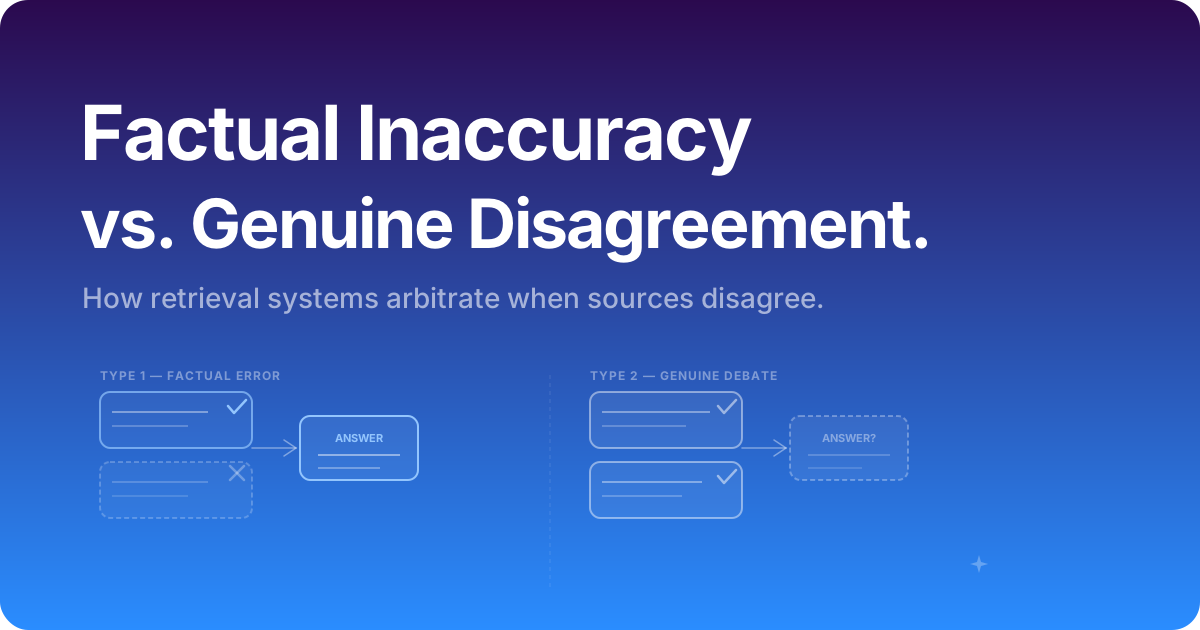
The DRAGged into Conflicts paper (arXiv, June 2025) established a two-type taxonomy that makes the distinction precise:
Type 1: Factual inaccuracy. One source is wrong. A software application was launched in 2022, not 2019. A drug interaction exists, or it doesn't. The scientifically correct system behavior is to identify and discard the inaccurate source, then answer from the accurate one. This is a retrieval-and-discrimination problem.
Type 2: Genuine evidential disagreement. Multiple sources reflect legitimately competing claims, contradictory clinical trial results, genuinely contested policy interpretations, emerging research where the field hasn't converged. The correct system behavior here is the opposite: surface the competing claims neutrally rather than arbitrate between them as if one side were simply wrong.
The reason this taxonomy matters is that the two types require opposite responses.
A system that defaults to synthesizing a single authoritative answer performs correctly on Type 1 conflicts and incorrectly on Type 2 conflicts. A system that defaults to presenting multiple viewpoints performs correctly on Type 2 and fails on Type 1 by treating a factual error as a legitimate competing claim. Current deployed systems have no reliable mechanism to distinguish the types before selecting a response strategy; the June 2025 paper documents this inconsistency explicitly, and the research finding isn't that systems err in one direction consistently; it's that they err unpredictably depending on surface features of the query and retrieved documents rather than the underlying conflict structure.
The implication: when you're writing about a topic where genuine evidential disagreement exists in the indexed corpus, the AI system may, or may not treat your source as one legitimate voice in a contested space. It may treat it as the inaccurate source to be discarded. There is no clean signal you can embed in a piece of content that tells the retrieval system which type of conflict it's navigating. That problem is upstream of content optimization.
How retrieval systems actually arbitrate when sources disagree
Knowing that conflict types exist doesn't explain how systems choose between them in practice. The arbitration mechanism, how a RAG system reconciles retrieved text against its internal training, and how it selects between competing web sources, remains fundamentally unresolved.
An October 2025 study on RAG behavior states this directly: the interaction between retrieved evidence and a model's parametric memory produces unpredictable outputs. This conflict-resolution failure is a structural gap in AI architecture, not a simple deployment tuning issue that a minor model update can fix.
The Problem: Majority-Vote Bias
Layered on top of this structural gap is a documented bias that makes the arbitration problem worse:
- The RAMDocs Dataset (April 2025): Researchers found that standard RAG systems exhibit a strict majority-vote bias.
- The Flaw: When more retrieved documents support a given answer, the system tends to output that answer, even if those documents contain blatant misinformation.
The practical implication for B2B content teams: the volume and distribution of your brand's claims across the indexed web directly affect citation outcomes. You cannot rely on a single authoritative landing page. Because a RAG system's implicit heuristic treats corroboration as evidence of accuracy, your messaging must be consistently present across multiple third-party indexed sources to win the arbitration loop.
Architectures Evolve to Fight Misinformation
To solve this, system designs are shifting from single-prompt LLMs toward complex algorithmic safety nets.
The MADAM-RAG framework demonstrated that assigning retrieved documents to separate LLM agents to debate across multiple rounds before an aggregator synthesizes an answer dramatically improves truthfulness. Testing showed improvements of up to 15.80% on misinformation suppression.
Additionally, modern 2026 deployments increasingly use independent pre-retrieval layers (like ConflictRAG) to calculate source credibility scores before the LLM even reads the text.
For a specific set of high-risk query categories, the arbitration question doesn't apply because the search engine actively suppresses generative responses.
For example, Google's AI Overviews strictly restrict AI-generated answers for election-related queries, national security topics, and highly sensitive legal advice. For broader high-stakes categories like healthcare, the system operates on a razor's edge. Rather than suppressing health entirely, Google triggers AI Overviews on a vast number of medical queries, but aggressively enforces a reactive "surgical suppression" protocol. Following a high-profile investigation in early 2026 exposing inaccurate medical advice, Google manually stripped AI Overviews from specific query lines (such as certain liver, and cancer tests) where the contradiction risk was deemed too dangerous for automated arbitration.
The logic is straightforward: when the downstream harm potential is significant enough, the system triggers hardcoded safety rails, and no content is permitted to win an AI citation.
Measuring the instability: what the data shows
A SISTRIX study covering 82,619 prompts and 1,548,213 snapshots across six countries and three search engines (Google AI Mode, Google AI Overviews, ChatGPT Search) from December 2025 to April 2026 documented high weekly citation churn; a substantial proportion of cited domains dropped, or replaced between consecutive measurement windows. Identical queries, near-simultaneous execution, dramatically different citation outputs. This level of variance on identical inputs is not random noise in a stable system, it's a symptom of a conflict-resolution process that hasn't converged on deterministic outputs.
Together, these findings connect directly to the arbitration mechanism described in the previous section. If the interaction between retrieved evidence and parametric memory is unresolved at the architecture level, you'd expect citation outputs to be unstable, because the system is not applying a consistent resolution algorithm. The instability is the observable consequence of the unresolved mechanism. It's also measurable evidence against the narrative that AI citation follows patterns stable enough to optimize toward in the same way as organic search position ordering.
A March 2025 Tow Center for Digital Journalism study, reported by Nieman Lab, found that AI search engines fail to produce accurate citations in over 60% of tests, with Grok demonstrating a 94% error rate in a follow-up analysis. These aren't deployment maturity issues that a development roadmap resolves in a predictable timeline; they reflect architecture-level gaps in how conflict resolution currently works. Contradiction is user-detectable, and it changes engagement behavior measurably.
For B2B brands, this has a direct implication: if your brand's claims are part of a conflict pattern that AI search surfaces as contradictory, the trust consequence isn't abstract. It increases the research burden on the user and reduces the authority signal your content was meant to convey.
What you can actually do about it
None of the above means AI search citation can't be influenced. It means the influence mechanisms are different from organic search, and the strategies that follow from a correct understanding of those mechanisms differ from the strategies that follow from the wrong one.
1. Prioritize brand mention surface area over backlink accumulation.
An Ahrefs study of 75,000 brands found that brand web mentions correlate with AI citations at 0.664, versus 0.218 for backlinks, roughly a 3x difference. A separate Ahrefs analysis of 863,000 keyword SERPs found that the share of AI citations coming from top-10 organic search results dropped from 76% in July 2025 to 38% in 2026.
What the data does support: if the majority-vote bias in RAG systems means citation outcome is influenced by the volume of corroborating presence in the retrieved set, then distributing accurate claims about your brand across multiple indexed sources matters more than concentrating authority in a single well-optimized page. That's a content distribution question, not a traditional link-building question. It means syndication, earned media, third-party mentions, and analyst coverage all carry functional weight in AI citation, not because they pass PageRank-style authority, but because they increase the document count supporting your claims in any given retrieval set.
For B2B teams, this reframes the content distribution budget. The case for PR, analyst relations, and industry publication placements now has a direct AI search mechanism to point to, beyond the general "brand awareness" argument.
2. Structure claims so retrieval systems can discriminate them from the noise.
In Type 1 conflict scenarios, where your content is accurate, and competing sources contain misinformation; the majority-vote bias works against you if accurate sources are outnumbered. You cannot directly control how many inaccurate documents exist in the indexed corpus. You can control how clearly your content states and sources its claims.
Well-attributed, precisely structured claims are more likely to be retrieved as a coherent unit, and less likely to be misclassified. This means specific factual assertions with named sources, dates, and figures rather than general positioning language. A claim like "our platform reduces implementation time by 40% across enterprise deployments" is more retrievable in a specific form than a paraphrase. If a statistic has a named study behind it, cite the study in the content, not in a footnote format that retrieval systems often strip, inline, in natural prose.
Schema markup and structured data support retrieval accuracy. As of September 9, 2026, the general pattern across AI search systems is that structured metadata helps systems identify the type of content, and its claimed context, which reduces (though doesn't eliminate) the risk of misclassification in conflict scenarios.
3. Audit for genuine evidential disagreement in your topic area before assuming citation is achievable.
For B2B brands publishing in areas where legitimate scientific or industry disagreement exists, cybersecurity practices, data privacy regulatory interpretation, clinical outcomes in healthtech; the Type 2 conflict dynamic means AI systems may treat your content as one voice in a contested space regardless of how authoritative it is. That's the correct system behavior, and it's not a content quality failure.
The strategic response is to decide whether to publish positioned claims in contested territory or to publish explicit acknowledgments of the disagreement with your organization's reasoned position stated clearly within that context. The latter is harder to write but more likely to be retrieved and cited accurately in a system that's supposed to surface competing viewpoints neutrally, because you're giving it the frame it's looking for. If an AI system is designed to show both sides of a contested topic, a source that explicitly maps the debate while stating a defensible position is more useful to that system than a source that simply asserts one side.
4. Accept the suppression ceiling where it applies and route strategy accordingly.
If your queries fall into suppressed categories, document it, communicate it to stakeholders, and redirect the AI search optimization budget toward query types where citation is structurally possible. An AI search audit focused on suppression mapping is a more productive starting point than content optimization for categories where the ceiling is categorical, not competitive.
The takeaway
The two conflict types, factual inaccuracy, and genuine evidential disagreement, require opposite model behaviors, and current AI search systems apply neither consistently. The majority-vote bias documented in the RAMDocs paper means citation volume in the retrieved set affects outcome independent of source accuracy. The arbitration mechanism between retrieved evidence and parametric memory is unresolved at the architecture level, producing the citation instability SISTRIX, and others have measured. And for specific query categories, the platform suppresses rather than arbitrates, which no amount of content optimization can overcome.
The strategies that follow from this are different from traditional search optimization: broader distribution of accurately stated, precisely sourced claims; explicit engagement with genuine evidential disagreement rather than one-sided assertion in contested topic areas;, and early suppression mapping before any citation optimization work begins.
What doesn't follow from this research is that AI search citation is random or unmanageable. It's neither. It's governed by mechanisms that are different from organic search, partially documented, and actively being studied.
Nishan
Content strategist at Optigent, specialising in GEO, AI search visibility, and B2B content optimisation.