
The Death of the Click: Rethinking Success Metrics for an AI-First Buyer Journey
Most marketing leaders have already accepted the premise. Fewer searchers click through to vendor sites, and the decline is steep.
When a Google AI Overview appears, Ahrefs' February 2026 analysis of 300,000 keywords found the click-through rate for the top-ranking page was 58% lower. That is a sharper drop than the 34.5% the same firm measured in April 2025.
The harder problem is what comes next. Google's generative AI performance reports in Search Console, launched in June 2026, show impressions, but no clicks, no click-through rate, and no query data. The metric is eroding, and there is no native instrument to replace it.
This piece skips the question of whether clicks are declining. It addresses the measurement problem that follows.
If the click no longer represents buyer intent, what signals do? How do you instrument them in the analytics environment you have today? And how do you tell a revenue-accountable executive that the dashboard they review every Monday is built on a compromised number?
What the click was actually measuring, and why that proxy is breaking down
The click was never the outcome. It was a proxy for three things at once:
- Discovery. A buyer encountered your brand in a context where they were looking for help.
- Intent. They cared enough about the answer to leave the results page.
- Attribution. You could see the visit, tie it to a query, and follow it toward a conversion.
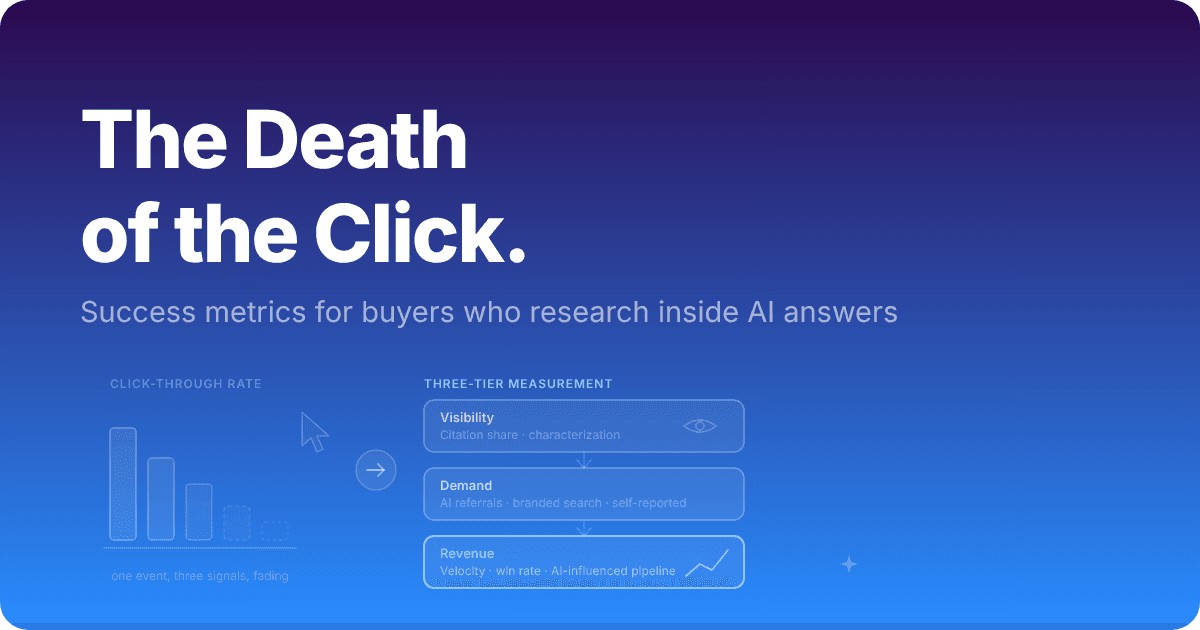
For two decades those three signals traveled together. One event carried all of them, which made the click the obvious center of every organic search report.
AI answers separate them. A buyer can now discover your brand inside an AI Overview, form an opinion about your category, and shortlist you without generating a click.
Discovery happened. Intent formed. Attribution was lost.
The click still records the third signal when it occurs. It has stopped reliably indicating the first two.
How large is the separation? The answer depends on whose study you read, and the spread is wide.
Reported reductions in click-through rate when AI Overviews appear include about 15% (Amsive, 2025), 34.5% and 58% (Ahrefs), 61% (Seer Interactive), and up to 79% for a page that previously ranked first (Authoritas).
Methods, query sets, and time periods differ. Anyone presenting a single figure as "the" number is simplifying a contested picture.
The trend line is not a straight line either. Seer Interactive's 2026 update tracked 53 brands, 5.47 million queries, and 2.43 billion organic impressions from January 2025 to February 2026.
Organic click-through rate on queries with an AI Overview fell to a low of 1.3% in December 2025, then recovered to 2.4% by February 2026. Headline numbers flatten that kind of partial rebound.
The point for operators is that click behavior on AI-answer queries is still moving, so a baseline set six months ago may already be stale.
Behavioral research points the same way. Pew Research Center's July 2025 study of the browsing activity of 900 US adults found users clicked a traditional result in 8% of visits when an AI summary appeared, compared with 15% when none did. Only 1% of visits included a click on a link inside the summary.
Taken together, the evidence supports a narrow conclusion.
The click is still worth counting. It is no longer a sufficient measure of whether your organic presence is working.
Where B2B buyers are now doing their research
If buyers are clicking less, they are doing their research somewhere. For B2B, the evidence increasingly places that research inside AI systems.
Forrester's found that when buyers use AI instead of search, they are one-tenth as likely to click through to a vendor's website.
B2B companies have seen traffic declines of 10 to 40% over the past year, which Forrester attributes to buyers adopting AI. Buyers now use AI to research product information (54%) and to compare offerings (55%).
Broader adoption figures vary with survey design, so each should carry its source:
- Forrester reports that 94% of business buyers now use AI in their buying process, up from 89% a year earlier. In its Buyers' Journey Survey, twice as many buyers named generative AI or conversational search as a meaningful source of information as named any other source.
- TrustRadius, in its 2026 B2B Buying Disconnect report based on 1,862 technology buyers surveyed in January 2026, found 63% used AI during their purchase journey. Of those, 94% fact-check AI answers at least some of the time.
The gap between 94% and 63% reflects different populations and definitions. Neither should be quoted without the other's context.
The TrustRadius fact-checking finding deserves attention on its own. Buyers who verify AI answers are still visiting sources, but they arrive to confirm something they already believe.
The most consequential figure concerns the shortlist. Bain & Company notes that research continues to show around 90% of buyers purchase from their "Day 1" list, the vendors they have in mind when the buying process starts.
If the consideration set forms before the first search, and that first search increasingly happens inside an AI system, the most important decision in your pipeline may happen entirely outside any channel you can observe.
The source of AI referrals is also fragmenting. A 30-day benchmark of more than 500 B2B SaaS sites put ChatGPT at 62.6% of trackable AI referrals, Claude at 18.5%, and Gemini at 10.6%.
A measurement approach built around one assistant will miss a growing share of the picture.
What remains measurable when clicks are suppressed or anonymized
Start by being precise about what Google currently provides, since many teams assume more than exists.
Google introduced the generative AI performance reports in Search Console on June 3, 2026. They cover AI features in Search, including AI Overviews and AI Mode, with a separate report for Discover.
As described in coverage of the launch, the reports show impressions by page, country, device, and date. They show no clicks, no click-through rate, and no query data. The impressions were already counted in existing Search totals, so the reports are a new view of existing data.
Google has said it plans to add metrics over time but has given no timeline, and the reports are rolling out to a subset of sites. Check Google's current documentation before you build a reporting process on any of this.
AI Mode is murkier. A January 2026 case study by Jean-Christophe Chouinard showed that AI Mode clicks are tracked in Search Console, but the queries behind them are almost entirely anonymized. Plan for partial visibility at best.
With those limits stated, here is what you can still instrument.
AI referral traffic in your analytics
Visits from ChatGPT, Claude, Gemini, Perplexity, and similar assistants often arrive with identifiable referrers. Build a dedicated channel grouping in GA4 or your analytics stack so this traffic is reported on its own rather than buried in "referral" or "direct."
Volume will be small relative to organic. The SEO Works' study of 95 websites from September 2025 to August 2026 found organic search delivered 39 times more traffic than AI assistants, with AI reaching 3.9% of organic volume by August 2026.
Small does not mean unimportant, but it does mean you should not judge the channel on volume.
Citation presence and share of voice
You cannot see Google's AI query data, but you can run your own. Define a fixed set of prompts that reflect how your buyers research the category: problem definitions, vendor comparisons, implementation questions. Run them on a regular cadence across the major assistants and AI Overviews.
Record whether your brand appears, whether it is cited with a link, how it is characterized, and which competitors appear alongside you. This is the closest available substitute for position tracking in AI answers.
A free AI search audit is one way to establish that baseline before you commit to an ongoing program.
Why citation, specifically
In Seer Interactive's 2026 dataset, brands cited inside an AI Overview earned about 120% more organic clicks per impression than when they were not cited. Seer's earlier 2025 analysis found cited brands received 35% more organic clicks and 91% more paid clicks.
Seer is clear that both findings are correlations, not proof of cause. Even so, citation works as a visibility signal with measurable downstream effects when direct AI clicks are low.
Decoupling from traditional search position
The overlap between AI Overview citations and Google's organic top 10 is shrinking. Ahrefs found about 38% of cited URLs also appeared in the top 10 in March 2026, down from about 76% in July 2025. BrightEdge's tracking puts the figure closer to 17%.
Whatever the precise number, organic position and AI visibility are related but drifting apart. Position tracking alone will overstate or understate your AI presence, and you will not know which.
Branded search and direct traffic
When a buyer learns about you inside an AI answer and later searches your name or types your URL, the AI exposure shows up as branded search volume or direct traffic.
Neither is a clean attribution signal. Both are worth trending against your citation data. Sustained growth in citation share alongside rising branded demand is a reasonable directional indicator. A single month's movement is not.
Self-reported attribution
Add a required "How did you hear about us?" field to demo and contact forms, with an open text option. Buyers will name ChatGPT, Perplexity, or "an AI search" when that is where they found you.
Alternatively, ask the question when you speak to a prospect.
This is the most underused instrument in B2B measurement, and it costs almost nothing to deploy.
How to reframe success metrics for a buyer who arrives pre-informed
The pre-informed buyer changes what a good organic visit looks like.
A buyer who arrives having already compared three vendors inside an AI system needs different things from your site than one starting cold. They also behave differently in your data.
The conversion picture is where teams most often overreach. Several widely shared claims say AI-referred visitors convert far better than organic. The evidence is mixed, and in B2B it is especially mixed.
The SEO Works' study found that across its 95-site dataset, AI referrals converted about a fifth better than organic overall.
That headline hides important variance. Sites in its B2B Products segment were the exception, converting at 0.62 times the organic rate. AI converted worse than organic on 23 of the 63 sites where the comparison was possible.
Contrast that with Adobe, which reported that AI-referred traffic to US retail sites converted 42% better than non-AI traffic in March 2026, after converting 38% worse in March 2025.
That is a retail figure, it reversed within a year, and it does not transfer to a B2B sales cycle.
Other published claims span an even wider range. An ecommerce working paper covering August 2024 to July 2025 found organic search converted 13% better than ChatGPT referrals.
Semrush estimated the average AI search visitor is worth 4.4 times an organic visitor, based on conversion rate. Ahrefs reported AI search visitors converted at 23 times the organic rate, for its own site.
The answer depends on the sample, the definition of conversion, and the baseline you compare against. Before you use any conversion-lift figure to justify investment, check all three against your own business.
The more defensible reframe is about what you measure, not about claiming AI traffic is inherently better:
- Measure velocity, not only volume. If AI-informed buyers arrive further through their research, the signal to watch is time from first touch to qualified opportunity and from opportunity to close. Compare that cohort against buyers from other channels.
- Measure the quality of the arrival. Track which pages AI-referred visitors land on and where they go next. Buyers who go straight to pricing, implementation, or security documentation are confirming, not exploring.
- Measure message consistency. If AI systems describe your positioning inaccurately, a pre-informed buyer arrives with the wrong expectations. Your citation audits should check characterization as well as presence. Inaccurate framing shows up later as stalled deals and objections your sales team cannot trace.
- Measure influence on deals you would have won anyway. Sales conversations surface AI influence that analytics cannot. Ask reps to log when a prospect references an AI answer, and what it said.
For a CRO, this reframe ties organic investment to pipeline predictability. For a CEO, it addresses a more basic question: whether the market is hearing a consistent story about the company in the places buyers now form opinions.
Building a measurement framework your organization will act on
A framework fails if it stays in the marketing team. The goal is a reporting structure leadership trusts enough to make budget decisions from, even though it carries less certainty than the click-based dashboard it replaces.
Organize it in three tiers. Each has a different job and a different level of precision.
Tier one: visibility. Are you present where buyers research?
- Citation share across a fixed prompt set, by assistant and by AI Overview
- Accuracy of how AI systems characterize your positioning
- Competitor co-citation patterns
- Search Console AI impressions, read as directional context and not as performance
Tier two: demand. Is that visibility producing interest?
- AI referral sessions, segmented by assistant
- Branded search volume trend
- Direct traffic trend
- Self-reported attribution naming AI sources
Tier three: revenue. Is interest turning into pipeline?
- Qualified opportunities with AI influence, from forms and sales notes
- Sales cycle length for AI-influenced opportunities against other cohorts
- Win rate for the same comparison
- Conversion rate of AI referral traffic, judged against your own baseline and never against a published benchmark from a different industry
Three rules make this usable.
Report the tiers together. Visibility metrics without revenue context look like vanity numbers. Revenue metrics without visibility context leave no explanation when pipeline moves. The value is in the relationship between the tiers over time.
Set expectations about precision upfront. Tell leadership plainly that the click-based dashboard was more precise than it was accurate. It measured one event cleanly while missing a growing share of buyer behavior.
The new framework is less precise and more representative. That conversation is easier before the first quarterly review than after it.
Retire click-through rate as a headline goal. Keep tracking it as a diagnostic. Stop setting targets on it.
A team held to a click-through rate goal on queries where AI Overviews appear is being measured on something largely outside its control, and it will make poor decisions to protect the number.
The framework also changes what the work itself prioritizes. If citation and accurate characterization are the leading indicators, content has to be structured so AI systems can interpret it, surface it, and cite it correctly.
Existing assets often carry the most leverage here. Optigent's AI search work starts by assessing where current pages fall short for AI retrieval, then improves them at scale.
Upstream of the content, the positioning itself has to be consistent enough that every asset reinforces the same story. That is the role of the Optigent Engine: the intelligence layer that keeps tone, positioning, and terminology aligned across everything you publish.
The takeaway
The click told you three things at once: that a buyer found you, that they cared, and where they came from. AI answers have split those signals apart, and the native measurement available today does not reconnect them.
The response is to measure each signal on its own terms. Track citation and characterization to understand visibility. Track branded demand, AI referrals, and self-reported attribution to understand interest. Track velocity and win rates for AI-influenced deals to understand revenue.
Read every external benchmark against its own sample and baseline before it touches your plan.
Organizations that make this shift now will have a year of comparable data by the time their competitors notice the dashboard stopped telling the truth.
Measurement built for how buyers research today compounds. Measurement retrofitted from the click era does not.
If you want to see where your brand stands in AI answers today, start with a free AI search audit or book a discovery call.
Nishan
Content strategist at Optigent, specialising in GEO, AI search visibility, and B2B content optimisation.