
60% of B2B buyers now shortlist vendors via AI. Most companies aren't on the list.
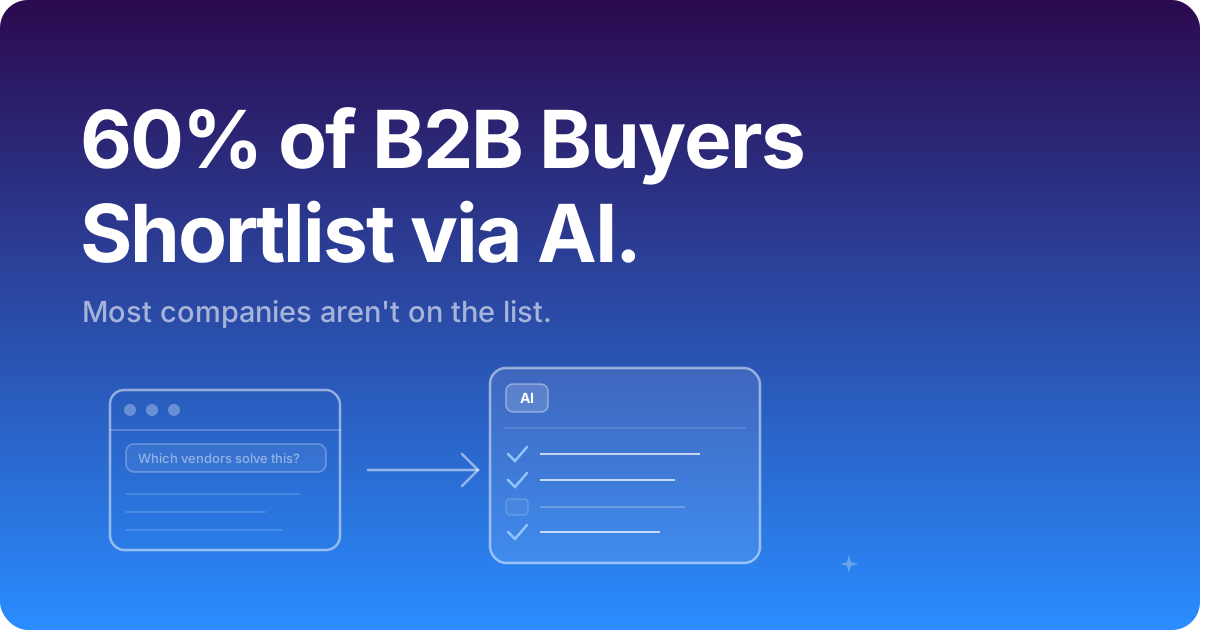
When a B2B buyer opens ChatGPT and asks which vendors solve their problem, they get a list. Your competitors may be on it. You may not be. Whether you appear in that answer has nothing to do with your brand awareness budget. It has everything to do with how your content is structured, attributed, and maintained.
This is not a hypothetical shift. It's already happening.
The buying journey has a new first step
60%of B2B buyers now use AI tools to build vendor shortlists before speaking to sales.
Google & National Research Group, Oct 2025
That number is significant not just for its size, but for what it means structurally. The buyer journey that marketing has optimized around for a decade assumed a specific order: awareness campaign, organic search, website visit, form fill, sales conversation. AI search disrupts that sequence at the first step.
Before a buyer ever visits your website, before they click a Google result, before your SDR sends a cold email, an AI system may have already decided whether you belong on a list of credible vendors. That decision is made without your input, based entirely on how well your content is understood by the AI doing the evaluating.
Most companies have no visibility into that decision. They don't know whether they appear. They don't know what the AI says about them when they do. They have no mechanism to change either.
This is a revenue problem, not a visibility metric
It's tempting to file this under "things to watch" rather than "things to act on." That framing is expensive.
4.4x higher economic value delivered by AI-referred traffic versus traditional search traffic.
Passionfruit & Ahrefs
The buyers arriving via AI-generated answers are further into their research. They've already filtered. They're comparing shortlisted vendors, not browsing categories. When your company appears in that answer, the commercial value is material. When you don't, you're not losing a click. You're losing a buyer who may never look further.
Gartner projects a 25% decline in traditional search volume as users shift to conversational AI. The channel that most B2B content programs were built to capture is contracting. The channel replacing it evaluates content on different terms.
The cost of absence in AI search compounds. Every month a competitor establishes visibility in AI-generated answers, the displacement cost for a late entrant increases. These systems continuously re-evaluate sources, but they favor sources with demonstrated authority over time. Getting there first matters.
Why strong marketing teams are still invisible
The most common situation we find in audits is a company with a real marketing function, a real content library, and declining organic visibility they can't explain. The instinct is to look for execution failures: bad content, inconsistent publishing, poor technical health. Those are rarely the cause.
The cause is structural. AI systems and traditional search engines don't evaluate content the same way.
Traditional search evaluates pages on signals that the last decade of SEO was built to optimize: backlinks, keyword presence, page authority. AI systems evaluate differently. They assess semantic clarity, entity alignment, how well a page's structure maps to the question being asked, and whether the source has been consistently maintained. A company can do everything right for traditional search and still be effectively invisible in AI-driven discovery.
The problem isn't the quality of the marketing. It's that the optimization target shifted.
What changes if you're on the list
When a B2B buyer builds a shortlist using an AI system, that list shapes the rest of the evaluation process. Vendors on the list get website visits, demo requests, and sales conversations. Vendors not on the list get nothing from that buyer. Not because they were evaluated and rejected. Because they were never surfaced.
The consequence for marketing is direct. Pipeline that should be attributable to content investment is instead going to competitors whose content is better aligned to how AI systems select sources. Those competitors may not have better products. They may not have larger budgets. They have content that's more legible to the systems now making the initial shortlisting decision.
That's a solvable problem. But solving it requires understanding what AI systems actually evaluate, not just what traditional search engines rewarded.
Where to start
The first step is knowing where you stand. Most companies don't have an accurate picture of how their content performs in AI-driven discovery. They know their traditional search metrics. They don't know whether AI systems are surfacing them in answers relevant to their category, what those systems say about them when they do, or where the structural gaps are.
That picture is what a proper AI search audit surfaces. Not a general content review. A direct evaluation of how AI systems currently interpret your pages, where the signal gaps are, and what would need to change for your content to be selected as a source.
The buyers are already using AI to build shortlists. The question is whether your company is on them.
Run the free AI Search Audit.
See exactly how one of your pages performs in AI-driven discovery.
Get Your Free AI Search Audit
Nishan
Content strategist at Optigent, specialising in GEO, AI search visibility, and B2B content optimisation.